

State House 101
In early 2025, shortly after Donald Trump returned to office, his administration moved aggressively to attack a series of marginalized communities. They launched a new wave of aggressive immigration enforcement policies: expanding ICE raids in major cities, threatening mass deportations, attempting to strip federal funding from sanctuary jurisdictions, and reviving efforts to fast-track detentions and removals. Several high-profile violent deportations in Massachusetts brought national attention to atrocities committed by ICE here. Trump and his allies also continued to target transgender Americans, banning transgender people from the military, blocking gender affirming care, and restricting identity-affirming passports.
Citizens across the Commonwealth of Massachusetts reacted with fear, dismay, and anger to the actions of the Trump administration. Massachusetts is a Democratic trifecta state, with Many called upon state leaders, including Governor Healey and the leaders of the two supermajority chambers of the legislature, to pass common-sense policies to protect citizens from the Trump administration and shore up civil rights at home.
Instead, the legislature embarked upon the slowest start to a legislative session in over 40 years.
Meanwhile, in Florida, the Republican state government adopted a social media ban that required users to verify their age by submitting biometric information for AI recognition or submitting their government ID to a third-party website owned by a Silicon Valley tech company, which had no restrictions on how long it could store that data.
Act on Mass is a non-profit organization that doesn’t take money from corporations. Small dollar donations from every day people like you are what sustains our movement. Please support our mission by becoming a donor today.
This policy has obvious privacy risks and puts targeted communities at risk, which is not surprising for a state under Republican leadership. However, in April of 2026, the Massachusetts statehouse passed the same policy, with much of the same exact language. House leadership described the bill as “among the most restrictive in the entire country.” The bill is a great example of how bad process leads to bad policy.
The bill was not public until April 6th, it passed out of committee on April 6th, and received a floor vote on April 8th. Giving advocates almost no time to investigate, sound the alarm, warn constituents, and organize protests. The bill received no public hearing, and there was no time for the public, data privacy experts, parents, teachers, and youth to give their opinions. It passed 129-25 with just two progressive Democrats voting no.
The statehouse often spends years kicking the can down the road on legislation that advocates are actually asking for, but this bill came out of nowhere, reflecting problems with the process. Without enough time to even read the bill, House leadership got an overwhelming majority of the Democratic caucus to fall in line. The statehouse often intentionally moves fast on controversial issues to avoid public pressure. We need to examine the house rules that allow for a leadership so powerful that the entire caucus falls in line.
Here are 10 issues with the Massachusetts State House:
1. There is no record of how our legislators vote most of the time
For years, one of the biggest transparency problems on Beacon Hill was the lack of recorded votes in committee. Popular bills could quietly die behind closed doors through voice votes or by being “sent to study,” leaving constituents with no idea who actually killed them.
After years of public pressure, we won partial changes to the legislative rules. Under the new rules adopted for the 2025–2026 session, committees are now required in many cases to publicly record how members vote on bill extensions and study orders.
But Beacon Hill leadership quickly found a workaround.
Instead of formally voting to kill controversial bills, committees can simply… do nothing.
Under the Legislature’s Joint Rules, most bills are supposed to receive action by certain deadlines. Traditionally, committees would meet those deadlines by reporting bills favorably, adversely, or by sending them to study. Now that some of those actions create a public paper trail, leadership has increasingly relied on another option: allowing bills to “time out.”
The bill to allow state house staffers to unionize met its fate this way. Rather than voting against it, they just missed their deadline and the bill died without any record of who was fighting for it and who killed it. When a bill times out, we get
- No recorded vote.
- No public debate.
- No explanation to constituents.
- No accountability.
The legislature has a pattern of finding loopholes to skirt its own rules and even of breaking them outright. A software developer created a website to track how often the legislature complies with the rules and found that on a majority of bills, the legislature did not comply with its process rules.

The most common violation was failing to post votes. Our legislators are fighting so hard to keep their constituents in the dark on how they vote.
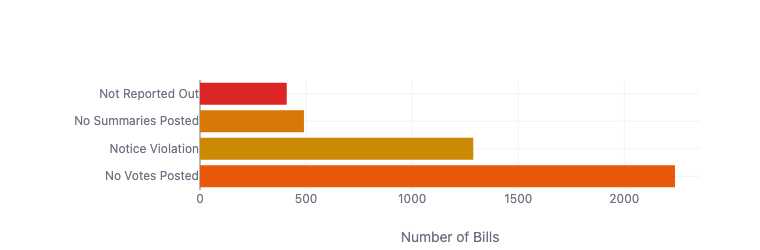
The impact is enormous. Bills with broad public support, including legislation on tenant protections, public records reform, prison oversight, climate action, reproductive healthcare protections, labor rights, and public transit funding, can accumulate dozens or even over a majority of co-sponsors and still quietly disappear through procedural delay.
In total, 704 bills were sent to study without a public vote thanks to committees abusing the procedural timeout. On average, 171 days passed between the deadline and the formal study order. Below are the five committees that use this loophole the most.

In many cases, lawmakers can continue publicly claiming they support a bill because they never had to cast a vote against it.
That creates a system where legislators are rewarded for symbolic support rather than meaningful action. A representative can co-sponsor a popular bill, promote it in campaign literature, and speak positively about it publicly, while leadership ensures it never reaches a vote.
For constituents trying to evaluate whether their elected officials are actually fighting for their priorities, this makes genuine accountability almost impossible.
2. The Legislature’s website has very limited information
Massachusetts legislators often defend Beacon Hill’s transparency by pointing out that legislative information is publicly available online. Technically, that is true. In practice, finding and understanding that information can feel like navigating a maze.
The Legislature’s website remains difficult to search, difficult to navigate, and difficult to interpret unless you already understand the procedural language of the State House.
A resident trying to follow a bill often encounters a confusing trail of extensions, redrafts, consolidated amendments, committee referrals, and procedural deadlines. Key information is scattered across multiple pages and PDF documents. Sometimes a bill’s page appears inactive even while major negotiations are taking place behind closed doors.
For example, a constituent attempting to track a housing bill might discover that the bill was reported out favorably, then replaced with a redraft, then folded into a broader package, then referred to another committee, then quietly delayed for months without any clear explanation. At each stage, there may be little indication of who made those decisions or why.
For example, here is the information that the legislature’s website provides for House bill 2078, which would allow certain public employees the right to strike, for this most recent session.

This set of actions is really difficult to decode if you aren’t a Beacon Hill insider. Months of inaction followed by a study order allowed the bill to be quietly killed, and if you want to know if your rep. is to blame, too bad. No committee vote was held.

In many cases it seems that the website is designed in a way to make it intentionally hard to track. In fact, legislators get access to a different website that they use to track bills, even they can’t track their own website.
Even experienced advocates and journalists regularly struggle to follow legislation through the process. For ordinary residents with jobs, families, and limited free time, meaningful participation becomes even harder.
The result is a system where information exists in fragments. Transparency depends less on whether records technically exist and more on whether ordinary people can realistically access and understand them.
3. Most bills are “sent to study,” which is just a euphemism for killing a bill
Session after session, we see popular progressive bills die in our state legislature, without any action. This is even the fate of policies codified in the party platform of the Massachusetts Democratic Party, like same day voter registration, or public committee votes. Upon investigation, these bills are almost always “sent to study,” a convoluted and opaque process that shields our legislators from progress and accountability and allows them to quietly kill bills.
When news reports on the bill reference “a study,”a voter might think that the legislature is actually doing some investigation, hearing expert testimony, and even doing analysis of the implications of a proposal. The polite language hides what’s really going on though, since practically every time a bill is “sent to study,” there is never an actual study or report on the bill. So what’s really going on here?
Before a bill can come before the House or Senate for a full vote, it gets sent to a committee for preliminary consideration. There are three different types of committees in the legislature – House, Senate, and Joint committees. The House and Senate committees only have members from their corresponding chamber, but the Joint committees have members from both chambers of the legislature. Joint committees are where the bulk of legislating happens.
During a committee vote, the committees have three choices:
- Report it favorably: rule that the bill “ought to pass” and pass it along to the next step in lawmaking (rare)
- Report it adversely: rule that the bill “ought NOT to pass” and kill it (even more rare)
- Send it to Study: rule that a bill be studied further and reported on by a later date, and pretend it might still pass. However, the vast majority of the time, no study is ever done, no report is ever produced, and sending a bill to study is a euphemism for killing the bill (fairly common)
For a sense of how often each of these options are exercised: of the 275 items that the Committee on Public Safety & Homeland Security reported during 2017-2018, they only reported a single bill adversely. (0.36%). The Joint Committee on Housing reported none of the 165 bills it considered adversely. (0.00%).
Voters would be better served by Committees actually exercising their power to vote bills up or down and going on the record supporting or opposing certain bills. There are bills introduced by conservative Republicans who you would expect the legislature to kill, yet they aren’t. Why are legislators shirking their duty?

Perhaps it is because it only takes less than 50 words to kill a bill!
The catch here is that co-sponsors of bills – or legislators that support a bill and present it for consideration – do not always vote favorably for those bills during committee votes.
The bill to Prevent Wage Theft (H.1868 & S.1158), which has plenty of co-sponsors and should pass easily in both the House and Senate given the Democrats’ supermajority, has faced pushback despite its popularity. Representatives have made it a habit to cosponsor bills that they had no intention of ever advocating for or voting in favor of when push comes to shove. That’s why the Act to Prevent Wage Theft has had over a supermajority of co-sponsors and has never come to a floor vote.
A reason for the lack of action to pass the bill in both chambers stems from the lack of transparency and accountability that occurs in committees and during committee votes.
4. Committee reports leave out crucial information
When a committee makes a decision on a bill, they do so on the basis of many hours of expert and public testimony, documents that committee staff compile, and discussions on the committee.
Yet when a bill is reported, the committee doesn’t include any of that. In other states like California, the committee report includes a list of who testified about legislation and whether they supported or opposed it. They think their residents deserve to know if, for example, a healthcare insurance executive testified against singlepayer healthcare, or if a Senior Executive at Exxon testified against a bill to tackle climate change.
In Massachusetts, all this information is diligently compiled by the committee staff, and then put in a secret file somewhere instead of being published.
The public deserves to know what information led a committee to decide one way or another.
Additionally, when the committee advances or kills legislation, they don’t have to give a reason. When the Safe Communities Act was killed (by “sending to study”), there was a 7 line study order that made no reference to the reason for the bill’s failure.

We don’t know why the 19 member committee voted to kill the bill. We don’t have any public report on who testified against the bill.
5. The public hearing process is broken and favors corporate lobbyists
During committee hearings, constituents are able to speak in favor of or against bills that are being considered by committees. These committees then take what they hear their constituents argue during the hearings and decide whether certain bills “ought to pass”, “ought not to pass”, or are “sent to study.”
Or do they?
According to a study conducted by The Climate and Development Lab at the Institute at Brown for Environment and Society, this is not always that case. In fact, many important bills that are considered by committees actually result in decisions that go directly against popular testimony from the public.

In this study, figure 2 shows the amount of support that climate-friendly bills get during public testimony. Individual testimony coming from constituents is 9-to-1 in favor of environmentalist legislation and makes up the majority of testimony that is delivered. The opposition for these bills is comparatively miniscule, so it would only make sense for clean energy and climate legislation to be passed by legislators. However, this is not the case.
That same study found that the utilities lobby (think Eversource and National Grid) actually have distinctly better success rates of passing their legislation. Why is that?
“Of the 245 climate and energy bills introduced over a six year period, only 43 made it out of committee to a floor vote. Nearly every committee that determined those outcomes voted in secret, leaving little opportunity for the public to hold legislators accountable for voting against climate action. Bills all went through the powerful and obscure Ways and Means Committees and then conference committees, where they were drastically rewritten.
Furthermore, all of the votes on climate and clean energy happened via voice vote, so at no step of the process was any individual senator’s or representative’s position on a bill recorded.
The committee votes that determine the bulk of legislative outcomes in the state, beyond occurring in secret, also happen under tight control by legislative leadership. The House Speaker determines who is on each committee, along with the budgeting process, party campaign funds, and the flow of information. As one interviewee put it, “It does seem that the House is a dictatorship and not a democracy.”
6. Bills and amendments are rushed through with no time to review them before voting
In contrast to the long waits that bills can suffer in hearings, when the Speaker wants to take action on a bill, they can move it incredibly quickly.
In 2018, the so-called “Grand Bargain” bill to raise the minimum wage had been held in committee for months as activists advocated for passage. Then, suddenly on June 20th, the Ways & Means committee reported out a new version of the bill, and the Speaker ensured that the bill was taken up and passed the same day. Less than 24 hours is not sufficient time for Reps to read a new draft of a 38-page law dealing with a number of complicated issues.
It’s not sufficient time for legislators to consider which amendments they want to file to strengthen the legislation and seek support from their colleagues on those votes.
Remember, to get a recorded vote on any amendment, you need to have 10% of the body, 16 members, stand in a 5 second window to demand roll call. When a bill is rammed through the chamber in less than 24 hours you have no hope of making meaningful amendments.
There were only 5 amendments filed on this bill on June 20th, and only 1 of them was adopted: An amendment written by the chair of the Ways & Means committee, who had just reported out the bill earlier that day. His amendment? Technical fixes to the language of the bill he had reported out in a rush earlier to ensure the language the Reps were voting on passed legal muster.
Forget about meaningfully impacting legislation passed in such a rush. Most reps didn’t have time to read to bill and understand what they were voting on!
In Jan 2019, Jonathan Hecht attempted to pass a new rule in the House that Reps be given 72 hours to read legislation before voting on it. Leadership spoke against this rule and defeated it, ensuring that Reps continue to be in the dark on what they’ve voting on in many cases.
Not only do Reps not know what they are voting on – constituents don’t have the time to look into and speak on behalf of legislation with such short notice. That’s why Act on Mass helped to create the People’s House Campaign to reform our legislature. In 2021, we presented two amendments to the House Rules that would have required at least 48 hours, or at least 72 hours to review legislation before coming to a vote. The former was unsuccessful, receiving a mere 39 votes in favor. The amendment for 72 hours never came to a vote and was killed by leadership.
7. Amendments are killed by leadership and vanish without any explanation
Because bills are often killed in committee, it’s a necessity for our legislators to try to advance bills via amendment to other bills, oftentimes through the budget, one of the only laws the legislature is legally required to pass each session. The Senate attempted to pass part of the Safe Communities Act through a budget amendment, for example.
After a bill is put in the Order of the Day, meaning it will come up for a vote the next day, there is a certain time period, sometimes very brief, during which legislators can submit amendments, and then they can “co-sponsor” the amendments of their colleagues.
Unfortunately, it’s common practice for leadership to take electeds one-by-one into closed offices and demand that they withdraw their amendments.
Now, it would sometimes make sense for an amendment to be withdrawn, if for example someone else submitted the same amendment and it passed. But in most cases, this is a method of leadership ensuring that issues they don’t support don’t come up for a vote by the full House.
During the 2017 Criminal Justice Reform debate, 82.8% of all amendments were withdrawn. Very few of them were passed by other means.
Another way amendments can “vanish” is through the consolidation process. This is where leadership takes all the amendments filed to a bill (this could be in the thousands for the budget, for example) and categorizes them into consolidated amendments.
Let’s consider this example: the summary of consolidated amendment A says it contains amendments 1-6. But when you look into the actual text of consolidated amendment A, it only contains 2, 4, and 5. Who chose that? Leadership. And of course, it was behind closed doors. When this happens, we say amendments 1, 3, and 6 were “consolidated away” meaning it looks like they were considered, but in reality, they just vanished behind closed doors.

Consolidated amendments only get one vote, meaning that it can be an “all or nothing” result. They are typically seen as pre-approved by leadership, and therefore are expected to be voted on favorably, despite often lacking key issues. In practice, consolidated amendments usually pass unanimously or near-unanimously.
8. Leadership use committee assignments (and the stipend that comes with them) to manipulate legislators and their votes
Above, we outlined that bills mostly die in committee. The committee chair enforces what leadership wants and won’t let meaningful bills come up for a vote. But what happens if a committee chair decides to advance a bill that leadership doesn’t support?
They are brought into the same closed-door office meetings that happen all too often, and the implication is that if the right outcome doesn’t happen, the chair might lose their committee chairmanship.
Losing a chairmanship means you lose the stipend leadership gives you for being in that position. You could also lose your fancy office and be shunned to the basement. Leadership can even force you to have less staff, a worse parking spot, or be socially and professionally alienated within the walls of the State House.
For a state representative, stipends attached to committee chairmanships can make a big difference on your salary, 149 out of 200 state legislators are stipended. This chart shows the current pay distribution in red and the pay distribution that would occur if the stipend reform ballot initiative that we are backing passes and is implemented in blue.

Many of the committees that lead to stipends for their chairs and vice-chairs don’t meet, don’t consider bills, and don’t hold hearings. They are ghost committees whose sole purpose is to create an excuse to get more members stipended.
Think this sounds far-fetched? It’s not.
In 2017, Rep Russell Holmes was stripped of his committee vice chairmanship after making public comments mildly critical of the Speaker (which is definitely not a coincidence).
Former Rep Diane Provost, who was in the House both before and after a majority of members received leadership stipends, said that “with more members in leadership positions, the House became more hierarchical and less collegial. Dissent lessened, dissidents became more conspicuous and marginalized.”
By standing up to leadership in ways that align with the wishes of their constituents, legislators run the risk of not only losing the little influence they have over legislation, but risk losing large portions of their salaries that are already pretty low.
9. Rank-and-file legislators are almost always going to vote with the Speaker and Senate President
There aren’t many votes recorded in the Massachusetts House, but if you look at the data as it exists, you’ll find something striking.
The vast majority of Democratic representatives vote the same as the Speaker of the House does 90%-100% of the time.
In the context of the Massachusetts State house, it makes sense that the House Speaker or Senate President could wield so much power without others in the State House putting them in check. If a bill is already on the floor, there is an assumption that leadership wanted it there. And if the Speaker wants the bill on the floor, then chances are they want it to be passed.
It’s common knowledge on Beacon Hill that the best way to advance your career as a Democrat is to follow the leader. This not only feeds into the lack of transparency, but it also promotes a toxic work environment for those in the State House.
In December 2018, Rep. Cory Atkins gave a farewell address to the House.After enumerating the many honorable statesmen and politicians who had worked in the House chamber since 1638, she contrasted the honorable history of the chamber by pointing out that now most people simply check the big boards on the wall to see how the Speaker of the House is voting and change their votes to match then-Speaker DeLeo’s.
During the 2019 Rules debate in the House, there was a prime example of this phenomenon in action. While voting on amendment #10 on H.2021, DeLeo’s light initially showed a “No” vote, and most democrats began voting against the measure.
What happened next is mind-blowing:
“As is often the case, many Democrats quickly took their cue from DeLeo and Petrolati and voted “no” as well. This is not an uncommon occurrence in the House. In this case it was at least 63 Democrats who played “follow the leader” and voted “no.”
As the board began to fill up with “no” votes, Petrolati apparently took notice and talked into a microphone he didn’t know was on. “It’s a yes?” “Switch ’em. Yes, yes, yes, yes yes, Mikey,” shouted Petrolati to Division Leader Mike Moran. Suddenly, DeLeo and Petrolati’s votes switched to “yes.” And then all 63 Democrat who had initially voted “no” suddenly switched his or her vote to “yes.””
When asked for comment later by Bob Katzen of the Beacon Hill Roll Call, Rep. Russell Holmes had a damning answer for what had just transpired: “Welcome to the House of Representatives. This is exactly how the House runs itself and the members should be ashamed. The speaker is like a shepherd leading a flock of sheep.”
10. The Speaker of the House and Senate President have all the power
The Speaker of the House and Senate President have near-unilateral power and control over their respective chambers due to a series of rewards and punishments they use to keep the rank-and-file in line. The Speaker and Senate President appoint and can fire committee chairs at will, and therefore control the flow of legislation.
Every two years, at the beginning of the legislative session, members of each chamber elect their leader by a majority vote. In theory, this means there can be a change in power with each legislative session, after each election. But in practice, we rarely see change at the very top, unless a leader retires or is carried out in handcuffs (yes, the latter is more common than you think).
Before holding a public vote on the floor, Democrats meet in a private caucus to select one Democrat to support. This protects this party from splitting their votes and potentially giving the position to a Republican. They then return to the floor to make a rare public vote, putting every rank-and-file legislator on the spot to choose the party’s pick or face retribution.
Given the ways in which the Speaker and Senate President can enforce discipline, taking a stand in caucus is just as bad as personally attacking them.
Until these rules and the general culture of secrecy in the State House are changed, we won’t see important bills passed.
The Budget Process
The budget is, in its simplest form, a statement of how the administration intends to spend money and finance projects over a fiscal year, based on estimates of expenditures during that period. In Massachusetts, the Governor, House, and Senate all get to propose their own budgets, and over the course of several months, they debate, add amendments, get public input, and eventually pass the final budget.
Phase 1
The Governor’s Budget
The annual budget process begins each year when the Governor files recommendations for the budget with the House of Representatives. The Governor is required to submit the budget proposal by the 4th Wednesday in January, or if it’s their first term, they have five more weeks.
Phase 2
The HOuse Budget
Prior to release of the House Ways and Means Budget, Joint Ways and Means Committee budget hearings are held across the state. The House Committee on Ways and Means takes the Governor’s proposal and releases their own recommendations for deliberation on the House floor. The full house then is allowed to propose amendments and debate their inclusion—there are often hundreds, if not thousands, of proposed amendments to the budget. Once the House approves a final, amended version of the bill, it is sent to the Senate for consideration.
Phase 3
The Senate Budget
Similarly to the House, the Senate Ways and Means committee will examine both proposals and then release their own budget for deliberation on the Senate floor. The full Senate can then propose their own amendments, debate them, and approve a final, amended version of the bill. It is then sent to a conference committee to iron out the differences between the Senate and House proposals.
Phase 4
CONFERENCE COMMITTEE
The House Speaker and Senate President each appoint three of their members to a conference committee to reconcile differences in each chambers’ proposal. One of the three members appointed from each branch must be of the minority party. The six members deliberate and report a final compromise bill to the House and Senate for a final vote of approval from each branch.
Phase 5
GOvernor’s Signature
The Governor has 10 days to review the budget and take action after receiving the approved compromise bill from the House and Senate. The governor can approve or veto the entire budget, but more often they will veto or reduce specific line items or sections. The governor can also submit changes as an amendment, which unlike vetos, would go back to the legislature for consideration. After any legislative overrides to the Governor’s actions (it takes 2/3rds of the legislature to vote to overturn a veto), the budget is finalized.
Glossary
Amendment
An amendment is a proposed change to a bill that is coming to a vote. Once leadership announces that a bill is going to be voted on the next day, lawmakers have a few hours to file amendments. Unless the filer of the amendment withdraws it, typically each amendment will be voted on; this is what constitutes the floor debate for any bill. It’s all but guaranteed that only the amendments that the Speaker/President has personally greenlit will pass. Sometimes filers will let their amendments die with a voice vote (i.e. no recorded vote), and sometimes they will request a roll call to see how each member votes. Only bills that are hand-picked by leadership will ever get voted on. For this reason, many lawmakers use amendments to other bills as their primary method for attempting to pass their priorities.
Bond Bill
Bond bills are not spending bills — they merely authorize spending for certain projects. In order to spend money on “capital,” i.e. state infrastructure, the Governor needs the specific projects and amounts to be authorized by the Legislature. If the Governor wants to be able to spend $1.6 billion on public housing repairs, for example, first she must file a bond bill for $1.6 billion on public housing repairs which must be approved by the Legislature. However, even the Legislature’s approval does not mean those funds are spent or those repairs will happen; it just gives the Governor the option. The Governor has 5 years to spend the money authorized by a bond bill before it expires
The Budget
The budget is, in its simplest form, a statement of how the administration intends to spend money and finance projects over a fiscal year, based on estimates of expenditures during that period. In Massachusetts, the Governor, House, and Senate all get to propose their own budgets, and over the course of several months, they debate, add amendments, get public input, and eventually pass the final budget.
Committee Hearing
Every bill filed gets a hearing over the course of the legislative session. The hearings are scheduled and held by the committee the bill has been assigned to, i.e. a bill related to prescription drug pricing is in the Healthcare Finance Committee, and they will conduct the hearing for that bill. These committee hearings are the one chance for members of the public to testify on the record in support of or against a bill. You can either submit written testimony (for which there is no requirement to make available to the public) or sign up to testify orally at the hearing. Hearing participation can now be virtual, or in-person. Bills do not get their own hearing; hearings usually cover dozens of bills grouped by topic. Because hearings include dozens of bills, they tend to last several hours. Members of the public who sign up to testify on a particular bill often have to wait 4, 5 hours for their turn to speak. The order of bills and people giving testimony is not made public in advance–you just have to be prepared to take the whole day off from work to give 3 minutes of testimony. Hearings only have to be scheduled 72 hours in advance, making it difficult to take time off work, prepare testimony, and organize a strong turnout. Hearings are always on weekdays, during “work” hours.
Conference Committee
Conference committees are temporary committees typically made of six legislators—three reps and three senators—appointed by their chamber’s leadership and tasked with making a compromise version of a bill or budget. Conference committees are notoriously opaque; they negotiate entirely behind closed doors and don’t have to offer any explanation for the final version they produce, which can no longer be amended. They also tend to work at a glacial pace. Sometimes, bills will be under conference committee negotiations for months before resurfacing. Worse, sometimes bills never make it out of conference committee at all, and die at the end of the legislative session.
Consolidated Amendment
The ability to file amendments to bills coming to a vote is the most power any rank-and-file legislator has. However, even this process is not immune to interference from leadership; leadership can choose to “consolidate” amendments into giant mega-amendments which will only get one vote. This is typically done during the budget process when legislators file 1000+ amendments. However, when these amendments are “consolidated,” they can also be rewritten or deleted entirely. For example, Consolidated Amendment A might “include” amendments 1, 13, 35, 37, and 40, but it actually only includes the language of amendments 1, 35, and 37. Thus, amendments 13 and 40 are effectively erased. It is presumed that members are expected to vote yes on any consolidated amendment because the contents have the blessing from leadership.
Informal Sessions
Informal sessions are where members of leadership will get together in the chamber and conduct business without the rest of the members present. Formal sessions, i.e. sessions in which all members are invited and present, are called by leadership when they want to. This can be as frequently as weekly, or they can go months without any formal sessions, as they did earlier this year. That’s right – most of the time when our lawmakers are passing laws, it’s with just a handful of reps present. Usually, informal sessions are used to pass non-controversial legislation; anything passed in informal session has to be unanimous – all it takes is one dissenting member to keep something from passing during informal. The problem with informal sessions is that the votes aren’t recorded, and rank-and-file members and the public don’t generally know what will be on the agenda in informal sessions until after they’re done.
Legislative Session
The legislative session is the time period in which the legislature operates, which in Massachusetts, is two years long, beginning on the first Wednesday in January of odd-numbered years. The legislative session is broken down into formal and informal sessions which have different rules for how they operate. All formal business must be completed by the third Wednesday in November of the first year. From that point until the first Wednesday of January in the second (even-numbered) year, the legislature sits in informal session. Then, the legislature is back in formal sessions until the last day of July of the second year, with the remainder of that year in informal sessions.
Any matters left pending at the end of the first year will carry over into the second legislative year in the same legislative status. Once the state budget is passed by both branches, the legislature may (but rarely does so) end the formal session by a vote of both branches and governor’s agreement.
Supplemental Budget
Every year the state government must pass a budget for the next fiscal year. The budget is typically negotiated and passed from April – June each year. In between budget cycles, the Legislature may pass a supplemental budget bill; this is a spending bill that is meant to appropriate additional funds that were not included in the most recent budget. A supplemental budget is typically filed by the Governor, and then goes to the Legislature for amendments and passage, if they so choose.
Study Order/Sent to Study
When a committee votes on whether to advance a bill to the next step of the lawmaking process or to kill the bill for the rest of the session, there are three actions they can take: they can: 1) report the bill favorably, meaning it continues to the next step of the process, 2) report the bill adversely, meaning it dies for that session, or 3) send the bill to “study,” also meaning it dies for that session, but with cuter language. The vast majority of bills filed in a given legislative session die by being sent to study, i.e. are “given a study order.” Unlike how it sounds, this does not mean that these bills will receive any kind of study–it’s just a way to subtly kill a bill using obscure bureaucratic processes.
Voice Vote
When the House or Senate vote on a bill or amendment, the vote can be taken one of two ways: a “voice vote,” or as a “roll call.” Voice votes, which are the default, mean that there is no record of which legislator voted which way–they aren’t recorded. Even worse, voice votes allow the legislative leadership presiding over the session to simply declare the outcome they want. In order to take a true, recorded vote, where the outcome isn’t dictated by leadership, lawmakers must request a roll call. Unfortunately, roll call votes are increasingly rare on Beacon Hill as decision-making slides further behind closed doors, and into the hands of just a few powerful individuals.