
It’s budget season in the Massachusetts legislature.
This week, the Massachusetts House “debated” and approved $63.4 billion of spending for Fiscal Year 2027. Behind closed doors, House budget chief Aaron Michlewitz and other leaders drafted the House’s budget and decided the fate of a record 1,737 amendments. Mostly local earmarks, these amendments which were dispensed with via seven massive “consolidated amendments.”Advocates are still poring through those enormous, multi-page amendments to figure out which measures were passed or rejected by this process.
As you can imagine, control over billions of dollars in state funds is a pretty effective fundraising strategy for Rep. Michlewitz and other legislative leaders. In the run up to budget season, Michlewitz has taken in almost $400,000 in campaign donations from a star-studded list of CEOs and lobbyists. Despite not facing an election challenger since 2009, his campaign account now sits at a whopping $1.6 million cash.
As it happens, it’s also budget season at Act on Mass.
Act on Mass is hard at work taking on the bigwigs of Massachusetts politics, getting the word out to the public and the press about their corrupt practices, pushing for democratic reforms at the ballot, working with our endorsement committee to prepare to support movement candidates, and getting ready to pound the pavement this summer for all of these things.
We do all that with an annual budget that is less than 1/16th of the cash currently sitting in Rep. Michlewitz’ account. As you can imagine, CEOs and corporate interests are not our biggest fans. We're proud to be a people-powered movement. And right now, we need to raise just $7,000 to keep our efforts going.
Luckily, our fundraisers are a lot more fun than the House budget! I’m so excited to announce that our annual spring fundraiser will be held on June 7th from 2-4 pm in Concord, hosted by our allies at Indivisible Acton Area and Indivisible Concord.

“Raising our Voices for Democracy in Massachusetts” will feature refreshments and musical performances from local groups, including a special guest: Auditor Diana DiZoglio! For those that don’t know: in addition to being an amazing ally for government transparency, Auditor DiZoglio is a talented singer with transparency-themed music on Spotify. We are excited to sing with Auditor DiZoglio and hear more about her current efforts with the legislative audit and the public records law question on June 7th!
If you’re able to attend on June 7th, buy a ticket today! Your contribution will support our fundraiser and we'll see you on June 7th.
RSVP TO 'RAISE YOUR VOICE' WITH AOM & THE AUDITOR 6/7>>
If you’re not able to attend, you can still support the fundraiser by making a donation today! Thank you for your support!
CAN'T MAKE IT? PITCH IN TO HELP US REACH OUR GOAL>>
---
State House Scoop
Non-binding SJC opinion casts doubt on our movement for stipend reform
On Monday, the Supreme Judicial Court (SJC) of Massachusetts released an advisory opinionthat raised doubts about the constitutionality of the stipend reform ballot question. It was heck of a first day back from vacation, I’ll tell you that.
Although this sounds like a career-ender for the stipend reform initiative, it’s more complicated than it looks. For one, legislators went around the traditional legal process to get this opinion, which is non-binding. The actual legal consequences remain unclear, and as of now, it seems possible that the campaign can still start gathering signatures in a few days.
What’s certain is that, whether through this ballot initiative or future efforts, the movement to reform the legislature’s corrupt stipend system will continue. Let’s take a look at how we got here.
The movement to "end loyalty pay" did not start and will not end with this ballot initiative
Act on Mass has been involved in the movement to “end loyalty pay” from its very beginning. We were one of the first organizations calling out legislative leaders’ power over members through unilateral control of their salaries. My predecessor (and former boss!) Erin Leahy helped write a comprehensive report, “The Massachusetts Legislature: Democracy in Decline,” which revealed just how anomalous this “loyalty pay” system is compared to other states. When I took over as executive director in 2024, I was thrilled to learn that we were part of a coalition seeking to target this unjust tool of hierarchical power in our legislature.
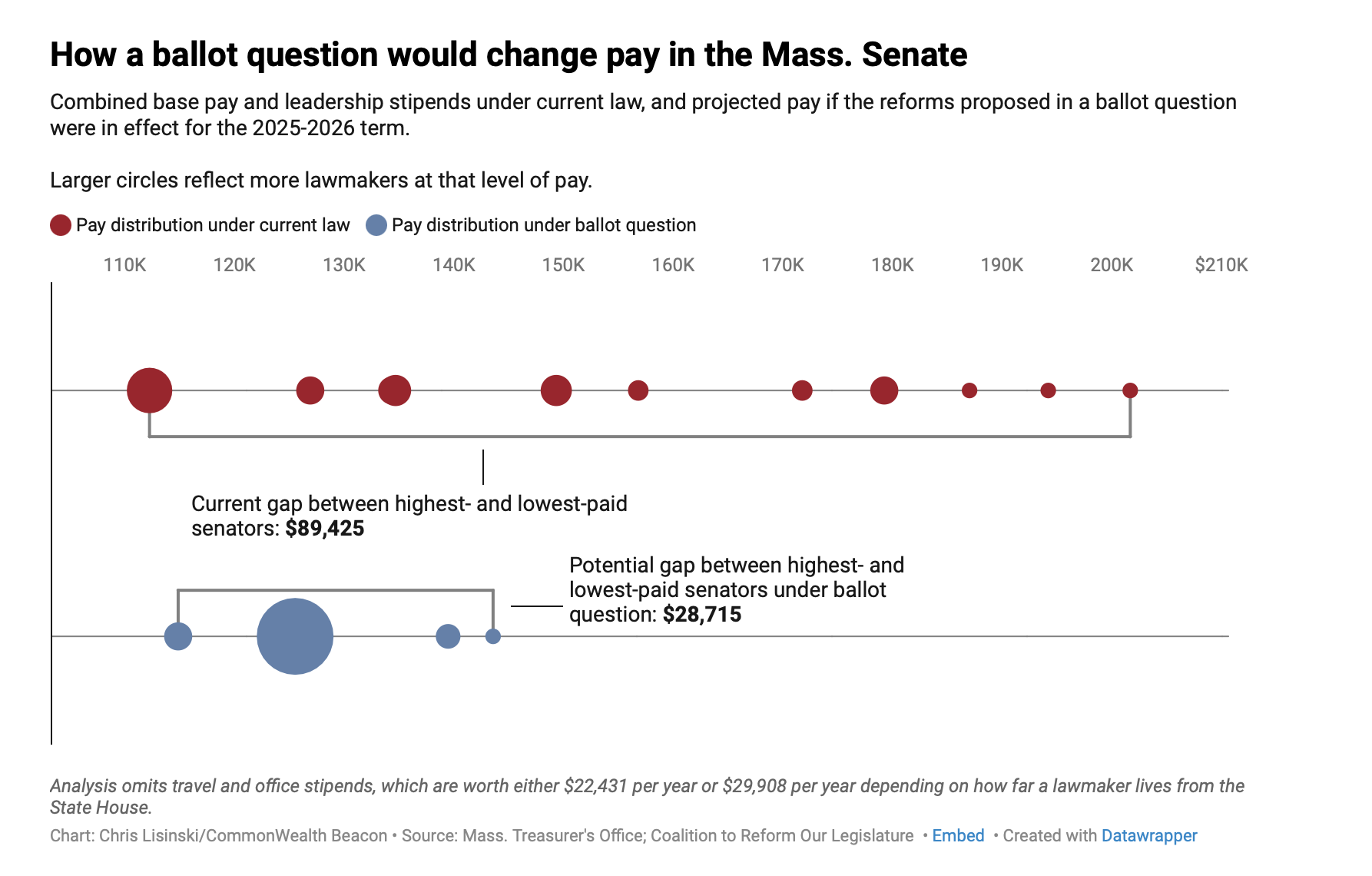
In 2025, Act on Mass was on the steering committee of the stipend reform ballot measure, which seeks to dramatically reduce the number of “stipends” controlled by leadership, raise pay for rank-and-file members to reduce pay gaps, and link remaining leadership pay to actual work in committees. Hundreds of Act on Mass supporters and allies organized last fall to gather signatures for the ballot measure from friends, family, and strangers.
It was clear from the beginning that legislative leaders would be resistant to this challenge to their power. They stand to lose the most from the reform: not only would they lose the ability to control pay for 75% of legislative members, but many leaders would see a cut in pay themselves, as their outsize benefits would be redistributed to restore fairness in pay. Here’s a graphic demonstrating how leadership pay would change under this ballot measure:
Knowing that the state’s most powerful would see this initiative as a threat, lawyers on the campaign team spent a long time hammering out the language of the ballot question, meeting with the Attorney General’s team to ensure that the question met criteria for a ballot measure.
There is significant precedent for the voters’ ability to regulate legislator pay via ballot measure. However, this question would also tie the disbursement of extra pay to certain practices within the legislature, which is slightly more complicated. The finalized language was carefully crafted; the attorney general’s team agreed that it was within the scope of a ballot initiative and certified it. The stipend reform petition went on to gather over 90,000 signatures, more than any other question proposed for the 2026 ballot.
After signatures are gathered, there is an established process to legally challenge ballot questions in court. The SJC requests that legal challenges be filed before the end of February, to allow time for full judicial proceedings before initiatives proceed to the next stage of signature gathering. At least three ballot questions drew legal challenges through this process. Stipend reform was not one of them.
Instead, the Senate voted in March to invoke a rarely-used provision to request the SJC for an advisory opinion on the constitutionality of the stipend reform measure and the public records law question. The state constitution grants the House, Senate, governor, and Governor’s Council this special right to ask SJC justices for opinions on “important questions of law, and upon solemn occasions,” without needing to file suit. The last time this right was used was 2016, for legislation. It is not traditionally used for ballot measures.
In explaining why the Senate opted for this step rather than filing litigation, Senate leaders apparently referenced the “downsides” of the “involved processes” of a legal challenge, “with a slew of motions and oral arguments that take up additional time.” This raised an eyebrow from me: the legal process that all other residents of the Commonwealth have to go through is too thorough for legislators, when they want to protect their pay and avoid public scrutiny? Reporters also pointed out that legislators might fear giving proponents “ammunition” by using taxpayer money to fund a full lawsuit against a ballot question. On that, I’ll say, they probably guessed right!
Instead of a full legal process, proponents and opponents were only able to file briefs in support of their positions. The Attorney General’s office actually filed a brief defending their certification of stipend reform based on legal precedent. The resulting advisory opinion of the Justices is short and offers little insight into their consideration of that precedent.
So where does that leave us?
Well, the Justices’ gripe with the stipend reform initiative concerns just one of its provisions: for the few legislators who would continue to receive stipends for committee work, disbursement of that stipend would be contingent on meeting certain performance standards, including holding public hearings and mark-up sessions. This would use stipends to incentivize transparent and efficient lawmaking, rather than loyalty to legislative leaders. The Justices disagreed with the Attorney General's certification, arguing that this provision impedes on legislative rule-making, and is inappropriate for a ballot measure.
This opinion is advisory and, as stated, outside the process of actually stopping a ballot question. Legally, it is unclear that this has any impact on the measure proceeding to the next phase of signature gathering. However, it almost guarantees that a true legal challenge to the measure will arise, before or after passage, and is likely to be successful.
The campaign and its supporters have a choice to make. Option 1: continue with the ballot measure signed by 90,000 Bay Staters and force legislators to go through the same legal process as everyone else to stop it from being decided by the public. This would require gathering 12,000 more signatures by the end of June to proceed to the next phase. Even if the question does get challenged in court, it could make a strong statement to the legislature that the public is paying attention to their unjust system of loyalty pay and demands change.
Option 2: the campaign could step back, and conserve resources for future challenges to the unjust stipend system. This is the approach promoted by the likes of the Boston Globe editorial board, who argued this week for a more encompassing reform for a stipend system that “cries out to be blown up.” It seems clear that a simpler initiative removing all stipends would face fewer legal challenges, but that would require waiting until next year for a (certainly doomed) legislative campaign or 2028 for another ballot initiative.
Whether you gathered signatures for stipend reform, told your neighbors about it, donated, pressed your state rep about just how much extra money they’re getting from leadership, or simply used the opportunity to do more research about legislator pay, you’re part of this campaign. What do you think the campaign should do? You can reply to this Scoop or email the stipend reform campaign directly at info@stipendreform.com.
I’ll end with some unequivocal good news: the Senate tried the same tactic to cast doubts on the public records law ballot question, and the SJC Justices’ returned an opinion that the question can proceed. This means that, either way, we will get the chance to demand further accountability from our legislators at the ballot this fall. I’m very much looking forward to that!
---
Lily's Lowdown: Legislature should codify program to get low-income tenants access to eviction court counsel
Massachusetts state law requires that defendants receive court-appointed counsel for defendants in criminal cases and some civil cases. When it comes to eviction proceedings, however, tenants are mostly left to navigate the complexities of the legal system on their own. 2024 data suggested that only about 3% of tenants were represented by lawyers in their eviction proceedings compared to 90% of landlords.
In 2024, following years of advocacy from housing activists, the Legislature took aim at this gross discrepancy and finally got “Access to Counsel Program (ATCP)” off the ground in the form of a line budget item. About $2.5 million is allocated to provide evicted tenants with attorneys. Those funds are managed by the Massachusetts Legal Assistance Corporation (MLAC), the organization that acts as a funding source for civil legal aid programs across the state.
The Legislature so far has only been willing to keep the program afloat through year-to-year funding. Bills have been filed to enshrine a tenant’s right to representation in law, but have failed repeatedly in our Legislature. As a line item in the budget, the program is at the whims of the Legislature, meaning it could be cut at any time. During an especially difficult budget year, this risk only increases.
Now in 2026, with budget season in full swing, the MLAC is asking for $4 million in funding for ATCP. The money they receive now is not enough, MLAC says, to keep pace with the 38,000 evictions handed down to tenants in the Commonwealth every year—more than 100 a day. Governor Healey has proposed to keep the program’s funding at just $2.5 million, and House Ways & Means has offered $3 million. The MLAC, however cites increased need and the success of the program behind their request for $4 million.
This program is essential toward ameliorating the housing crisis and rapidly rising cost of living. As renters flee rising costs in the Greater Boston area for Gateway Cities like Lynn, Brockton, Lowell, and New Bedford, they’re driving up rent prices in those communities. No doubt, this also has a racial dimension that demands our attention. MHP reports that Randolph—a community where more than half of all renting households are Black—consistently sees the highest rates of evictionamid accelerating rent costs.
Rectifying this in a more meaningful way will require a lot more than just line items in the budget, including meeting the need for more affordable housing. As for eviction representation itself, even though the money helps make a dent in providing counsel to tenants, inscribing it into law would allow the state greater oversight over the nonprofits providing services in addition to “[mandating] multilingual outreach, and [authorizing] contracting with private attorneys to expand capacity in underserved areas,” according to the Commonwealth Beacon's reporting.
There are other limitations on the program in its current capacity too. For example, it only extends its services to households with incomes at or below 125% of the federal poverty line, roughly similar to eligibility for the Supplemental Nutrition Assistance Program (SNAP). For an individual, this means an income just under $20,000 annually, which is disproportionate to the low-income guidelines in high-cost areas like Greater Boston.
All this is to say that the Access to Counsel Program is certainly not the cure-all for Massachusetts eviction ails. But the Legislature’s foot-dragging in making the ATCP law is handicapping its effectiveness and forcing it to precariously balance on the chopping block of the state budget.
---
Missed a Scoop or two? You can find a full archive of all past Saturday Scoops on our blog.
---
Immigration spotlight
As the toll of the Trump administrations' violent immigration enforcement actions continue to be felt in Massachusetts and nationwide, we wanted to continue highlighting local stories of how this is impacting Bay Staters and share calls to action.
- News: MA Senate reeased their version of the PROTECT Act this week and will vote on it next week. Here's more from the Boston Globe (paywall)
- Cooperation with ICE common among Mass. law enforcement, new report finds in GBH News
- How a fight over a parking spot landed an East Boston man in ICE custody in WBUR
- 'To Boston Police Dept. From: ICE:’ Late-night faxes pressing BPD to turn people over in WBUR
- 8 Mainers arrested while trying to deliver care packages to ICE detainees in Massachusetts in Maine Public

The Senate votes this week! Tell your senator to pass the PROTECT Act!
TELL YOUR SENATOR: PASS STRONG PROTECT ACT>>
---
What else we're reading this week
Essential reporting in local and national news this work
- A Black Man’s Death at the Hands of Police Is Going Unacknowledged by Naomi Bethune for the American Prospect
- Senate energy chair signals departure from House on $1B cut to Mass Save by Jordan Wolman for Commonwealth Beacon
- Disconnected SNAP calls contribute to thousands losing food assistance By Katie Johnston for Boston Globe
---
Progressive Mass Lobby Day! - May 7th, 10 am - 1 pm

Our allies at Progressive Mass are hosting their annual lobby day on May 7th. Join fellow progressives to lobby your legislators for must-pass priorities this session!
RSVP FOR PROGRESSIVE LOBBY DAY>>
---
Thanks for reading and for taking action! We'll be back next week!
In solidarity,
Scotia
Scotia Hille (she/her)
Executive Director, Act on Mass