Hi there,
These days, you can’t open a local paper without seeing stories about municipal budget crises. Rising inflation, skyrocketing healthcare costs, and a stagnation in aid from the legislature is pinching the pockets of our state’s municipalities. Towns and cities across Massachusetts—from small villages to the city of Boston—are having to lay off teachers, consider closing local libraries, and reduce municipal resources to break even.
Two weeks ago, we discussed the role of state lawmaker earmarks in perpetuating this crisis. When significant chunks of state aid to municipalities are reserved for lawmaker earmarks on budget bills, aid is distributed inequitably. Members favored by House and Senate leadership end up with big chunks for their district—regardless of need.
This week, some good reporting from MassLive zeroed in on what this issue looks like in our state’s rural districts. In South Deerfield and Amherst, some students have taken matters into their own hands, organizing for equity in state funding. At a recent state house budget hearing, a junior from Amherst Regional High School testified: “we are not getting what we need, and you are not doing enough to help us. We are not asking for the world, we are asking for the education that every child deserves.” Her classmate, a sophomore, had an explanation: “our schools are not having their needs met, because we receive the minimum aid increase.”
Indeed, the current state school funding formula, Chapter 70, distributes state funds based on fluctuations in student population: when enrollment does not increase, funding does not increase. School enrollment has been decreasing statewide, with rural districts seeing the highest drops in enrollment. With the last few years of rising costs and high inflation, this has led to budget crises that are particularly acute for rural schools. Although the legislature is supposed to revisit Chapter 70 every 10 years, its last review concluded in 2015.
We’ll be keeping an eye out for action on rural school funding and chapter 70 as the legislative session draws to a close. But as this week’s Scoop unfortunately demonstrates—legislative leaders aren’t exactly listening to the opinions of youth! Let’s get into it.
---
State House Scoop
On social media ban, House shows why “move fast and break things” approach to lawmaking creates bad outcomes
Following up on our action alert of this week!
On Wednesday, the Massachusetts House passed a social media ban for youth that House leadership described as "among the most restrictive in the entire country."
The social media ban was not filed as a bill in our legislature and did not receive a public hearing. I cannot stress this enough: nobody knew that the legislature was even considering a social media ban until Monday, when the bill was released. The public, data privacy experts, parents, teachers, and youth themselves had no warning and no say. Some democracy!
How did we get here? In July of last year, the Massachusetts Senate passed a bill (S.2581) that would ban cellphone use in public schools, expanding a policy that has already been implemented in towns around the state. The bill then moved to the House and has sat in House Ways & Means since with no action.
On Monday, with no warning, a new House version of the bill (H.5349) was voted out of committee. The new version contained the sweeping ban on social media usage for children under 14 and requirements for parental consent for 14 and 15 year-olds.
This is an unfortunately common tactic of state house leadership, which Act on Mass has organized against: moving quickly on controversial legislation before the public has the chance to respond. Rank-and-file representatives had less than 48 hours to read the new legislation before voting. Legislators spent most of Wednesday in a private caucus deliberating the fate of amendments behind closed doors, staying past 7 p.m. to finalize the legislation. There was little public debate, and the bill ultimately passed 129-25, mostly along party lines. Two progressive Democrats, Rep. Mike Connolly and Rep. Erika Uyterhoeven, opposed the bill.
Advocates and members of the public were left wondering: where did this bill language come from? Why the sudden sense of urgency? We’ve been trying to get them to take swift action against Trump for a year and a half, why does this issue get the fast track? Who asked for this? What implications will this legislation have?
Let’s investigate.
1. What does this social media ban actually mean?
If passed into law, this bill would have sweeping consequences for the use of the internet by all residents of Massachusetts. Indeed, the definition of “social media” in the legislation is extremely broad and would reasonably apply to platforms like Wikipedia and YouTube, along with any other user-based forums.
This bill would require all users of Instagram, Facebook, Twitter, Bluesky, Youtube, Wikipedia, TikTok, Substack, Reddit, etc. to a) confirm that they’re located in Massachusetts and b) prove that they are over 16 in order to hold an account on those platforms.
One example for how to approach this is the EU Digital Identity Wallet, which establishes a government platform for protected age verification. Instead, this bill language leaves it up to tech companies to decide how to verify user ages, using “the best technology available to reasonably and accurately identify a current or prospective user’s age.”
The problem is that the “best technology” for online age verification is faulty and fraught with privacy risks. Without a protected government platform, current approaches involve requiring users to either upload a government ID or submit images for unreliable AI facial recognitiontechnology. This would link your legal identity and biometric data to your activity online and state location, to be stored by the tech company. The bill only specifies that data collected by the platform for age verification should be “segregated” and “remain confidential.” No requirements for how long companies can hold on to your data or how it should be protected.
Biometric data, especially that connected to location and speech on the internet, is a valuable commodity. Some cases already provide a cautionary tale. The platform Discord saw a hack to its age verification program expose the government IDs of 70,000 users last year, with some linked to email addresses and IP addresses. Just this month, the Trump administration has ordered the social media company Reddit before a federal grand jury in an attempt to access the personal information of an anonymous user who criticized ICE’s immigration tactics. At a time of mass surveillance and a crackdown on political speech, any requirement to put biometric data in the hands of tech companies should not be taken lightly.
The bill language also requires that “social media” companies obtain “verifiable consent” from a parent to authorize accounts for 14 and 15 year olds, adding another wrinkle. Verifying parental consent is an even murkier landscape: how do you prove to a website that you’re legally the parent of a child? Would parents have to submit birth certificates to allow their 15 year olds to play on Roblox? In the case of a custody dispute between parents, who decides Instagram access? What about LGBTQ+ youth who are unsupported by their parents, but can currently find community online? What about foster children?
Regulation of big social media’s exploitative business model is deeply needed. However, enforcement is tricky and legislation should be well-crafted to succeed without creating additional risks. All of the above issues would have been raised by legal experts, data privacy advocates, free speech proponents (including the ACLU), parents, teachers, and youth themselves if this bill had actually gone through the legislative process. Alas.
On Wednesday, reporters asked House Speaker Ron Mariano “if lawmakers thought about data privacy as they prepared the legislation.” His response? “Well, I’m sure we have…”
I’ll let that speak for itself.
2. What is the precedent for this ban?
As communities and governments respond to the well-documented harms of social media, age verification laws for social media have been on the rise worldwide. Australia was the first countryto implement a nationwide social media ban for children under 16, following years of study and a public comment process that garnered over 15,000 submissions. At least eight U.S. states have passed age verification legislation for social media, with varying approaches.
Age verification laws have had pretty mixed results in actually getting kids off social media. In the United States, many of these laws have been caught up or blocked in litigation on free speech concerns. Australia’s ban has been labeled a “flop,” with 7 out of 10 teenagers still regularly using social media through VPNs and other means. Even for laws that cross legal hurdles, enforcement is a challenge.
Nevertheless, there is still a well-funded push behind age verification as social media regulation. Meta, Inc. is providing funding for a shadowy coalition of conservative organizations pushing age verification legislation at the app-store level in multiple states. Age verification is also backed by conservative groups like the Heritage Foundation.
Meanwhile, age verification legislation is opposed by the ACLU, landmark LGBTQ+ organizations like the Trevor Project and GLAAD, and a coalition of local LGBTQ+ and tech safety groups, who argue that this approach limits the freedom of speech, cuts off marginalized youth from community, and lets social media companies off the hook for practices (such as addictive feeds) that harm adults as well.
3. Where and how did this bill originate?
MA House leadership claims that the social media ban language was originally authored by Assistant House Majority Leader Alice Peisch. However, the Peisch bill cited, H.666, was not a ban and has little materially in common with the language added in H.5349.
Instead, the language of the proposed ban appears to be lifted directly from Florida’s social media ban passed in 2024. Here’s one section, for example:
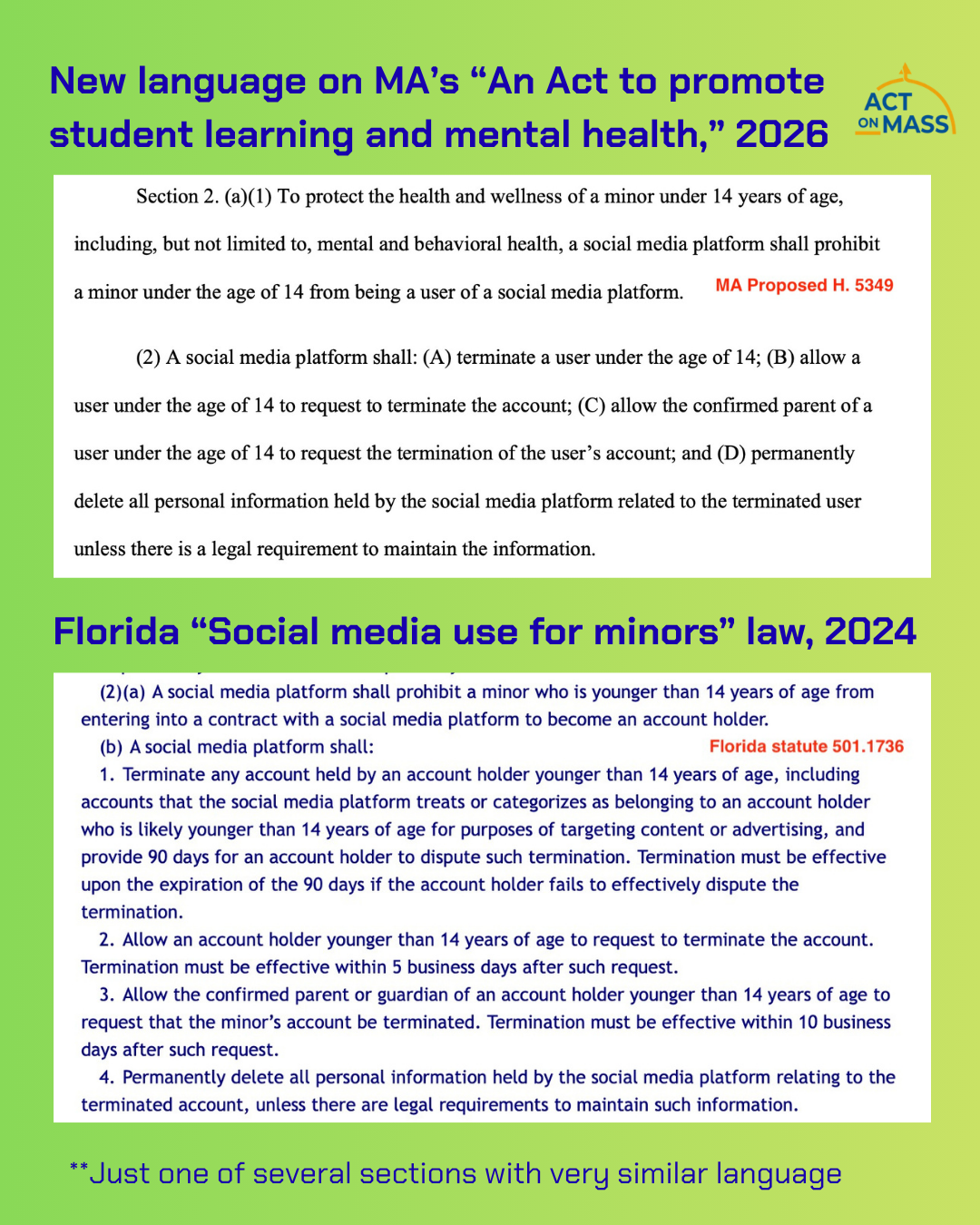
House leaders did acknowledge that out of all states, Massachusetts’ bill was closest to Florida’s. That seems to be an understatement.
Florida’s ban was sponsored by a Republican Senator, championed by the ultra-conservative Florida House Speaker, passed by Republican supermajority, and signed by Ron DeSantis. Florida’s own legislative research bureau flagged that the age verification requirement was likely unconstitutional. Indeed, like other age verification laws, it has been held up in federal court for the last two years over free speech. Why Massachusetts’ Democratic leaders chose to mimic this law, with no notice and no public process, is genuinely a mystery to me.
There might be an interesting story going on here, and I hope our state’s excellent journalists are hard at work tracking down how and why this bill emerged. I do find it interesting that Rep. Alice Peisch, the supposed author of the age verification language, received max-out campaign donations on April 1st from both of Meta’s MA-based lobbyists and one of Google’s. Legislative leaders want us to believe that they’re taking on big tech, while taking money from big tech’s lobbyists.
One thing’s for certain: whoever legislative leaders were listening to when crafting this bill, it wasn’t their constituents. Even though I track the shadowy Massachusetts legislature for a living, I’m astounded that a bill with such immense ramifications would move with no public process. Important questions about the harms of social media, age verification amidst mass surveillance, and protecting minors should have been considered in deliberative conversations among parents, caregivers, youth, and educators. Instead, we are left to assess the implications after the fact.
By tacking this language onto a bill already passed by the Senate, this is also an end-run around the bicameral process: senators will not get the chance to weigh in on this legislation. Instead, the bill will now move to a conference committee to negotiate the differences between the two versions. Conference committees are inherently undemocratic: leadership of each chamber will appoint just three members for closed-door negotiations. Still, it provides us an opportunity to apply pressure to make sure that this language does not become Massachusetts law.
We want our Democratic state legislature to regulate big tech companies, not send them our biometric data! Use our email platform to personalize an email to your rep and senator today:
TELL YOUR LEGISLATOR: PROTECT DATA PRIVACY>>
---
Lily's Lowdown: Blinded by Love - Governor Healey, OpenAI, and the Data Privacy Dilemma
Governor Maura Healey announced earlier this year that Massachusetts will be the first state to let OpenAI sink its teeth into residents’ personal data. Proponents argue that the introduction of AI tools for more than 40,000 state employees may help ease the workload on overstretched staff. Besides, if AI is here to stay, we might as well capitalize on its rise. But what about its potential for rupture?
Healey’s public zeal for ChatGPT, OpenAI,and OpenAI’s CEO Sam Altman—who, not-so-fun-fact, was briefly ousted by the OpenAI board for concerns over AI safety and transparency a few years ago—might feel new, but these gears have actually been turning since 2024. Two pieces of legislation passed by the legislature that year, the FutureTech Act and the Mass Leads Act, together dedicated millions of dollars toward the development of AI. Some of this funding has been put toward the development of AI tools to expedite various administrative tasks at MassDOT, the RMV, and DESE. Healey is also spearheading efforts to integrate AI into public school classrooms, both as a tool for teachers and as new curricula for students to learn “foundational concepts, technologies, and societal implications of AI.”
According to reporting from The Shoestring, the “AI hub” Healey envisioned back in 2024 is slowly coming into focus across state bureaucracies. Yet even as she touts the state’s first-in-the-nation partnership with OpenAI, Healey’s team remains tight-lipped about critical aspects of its use. Many of the government sectors involved deal with sensitive user data. The Executive Office of Technology and Security Services (EOTSS) refused to release critical records to The Shoestring that would prove it is following through on its data privacy promises.
Interestingly and troublingly, the Commonwealth’s partnership with OpenAI is unfolding at the same time as Trump’s federal government has enlisted OpenAI for its uses in the Department of War. Coupled with ICE's contracts to conduct mass-surveillance with Palantir's AI technology,, it’s a pretty tough sell that giving OpenAI access to the sensitive data of millions of people will guarantee a net benefit for Massachusetts residents. From almost every angle, particularly in tandem with the social media ban passed this week, it’s hard not to see an apparatus of mass-surveillance taking shape. Even with Healey’s promises that the technology will make the state government “faster, more efficient, and more effective for the people we serve,” answers from the Healey administration about what this means for data privacy concerns have been scarce. The explanation listed on the state’s webpage about Artificial Intelligence at the Commonwealth, under the transparency and accountability section of “How Massachusetts UsesAI Responsibly,” simply reads:
AI systems must operate within the rule of law and established ethical standards. We are open about how AI is used in the Commonwealth. We document decisions, monitor performance, and clearly assign responsibility. We evaluate and improve our AI systems to maintain public trust.
If this fluffy nonanswer isn’t reassuring to you, then the response Technology Secretary Jason Snyder offered in an interview with the Commonwealth Beacon won’t be either: when asked about the risks of OpenAI’s handling of sensitive data, he simply said, “if this data were to leave, it would be bad for OpenAI. It would be a public embarrassment.” Given some of the outrageous things OpenAI has said and done, relying on their PR skills is not exactly a foolproof plan.
And while the state continues to laud the Pandora's box of possibilities wrapped up in AI, its rhetoric noticeably skirts around the fact that the expansion of AI necessitates the expansion of data centers to sustain them. And opposition to those data centers, which produce noise and air pollution and raise electricity costs for host communities, is growing among communities. Lowell, home to a massive data center for Markley Group, passed a yearlong ban on data center expansion, and Everett is pushing to do the same.
There are other concerns, too, embroiled in the expansion of AI beyond data privacy and data centers (although these are important enough on their own.) As a Union Local 509 spokesperson Berthet Garcia articulated in a statement to the Shoestring, if state agencies are stretched thin, resources could be better put toward hiring more staff so that agencies like the Department of Transitional Assistance (which handles SNAP benefits) can answer more calls and serve more people.
Compared to state leaders’ unbridled enthusiasm for AI integration, each of these concerns reveal that AI is yet another dimension of opacity shielding the state from being transparent and receptive to concerns from residents. The state’s willingness to hand over an enormous amount of sensitive data to OpenAI without clear safeguards should alarm us all. Even if AI feels enticing right now, in the words of Sam Altman himself, “AI will probably, most likely, sort of lead to the end of the world. But in the meantime, there will be great companies created with serious machine learning.”
---
Missed a Scoop or two? You can find a full archive of all past Saturday Scoops on our blog.
---
What else we're reading this week
Good reporting from news outlets around the Commonwealth this week!
- Massachusetts has the highest electricity bills in the continental US. But some ratepayers pay noticeably less. (paywall) in Boston Globe
- More Massachusetts police officers are being prosecuted. Experts have theories as to why in MassLive
- ‘It’s been a very difficult year.’ Hunger just keeps growing in Mass. and a new report details how. (paywall) in Boston Globe
- Taking stock of Massachusetts health care reform at 20 in Commonwealth Beacon
---
Take Action
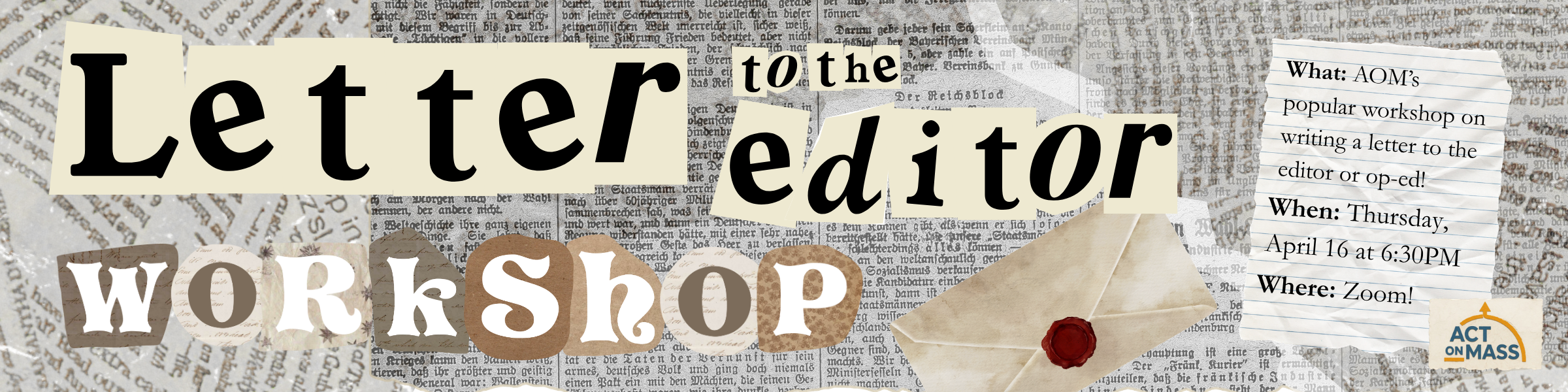
Let your voice be heard - join AOM's Letter to the Editor Workshop! - April 16th, 6:30 p.m.
Our workshop will cover best practices for drafting, editing, and pitching your LTE or op-ed using the push for stipend reform at the state legislature as an example. Whether you write about stipend reform or an issue of your choice, come review with us!
SIGN UP FOR OUR LTE WORKSHOP>>
People Over Profits Campaign Action Hour - April 14th, 7:30 pm
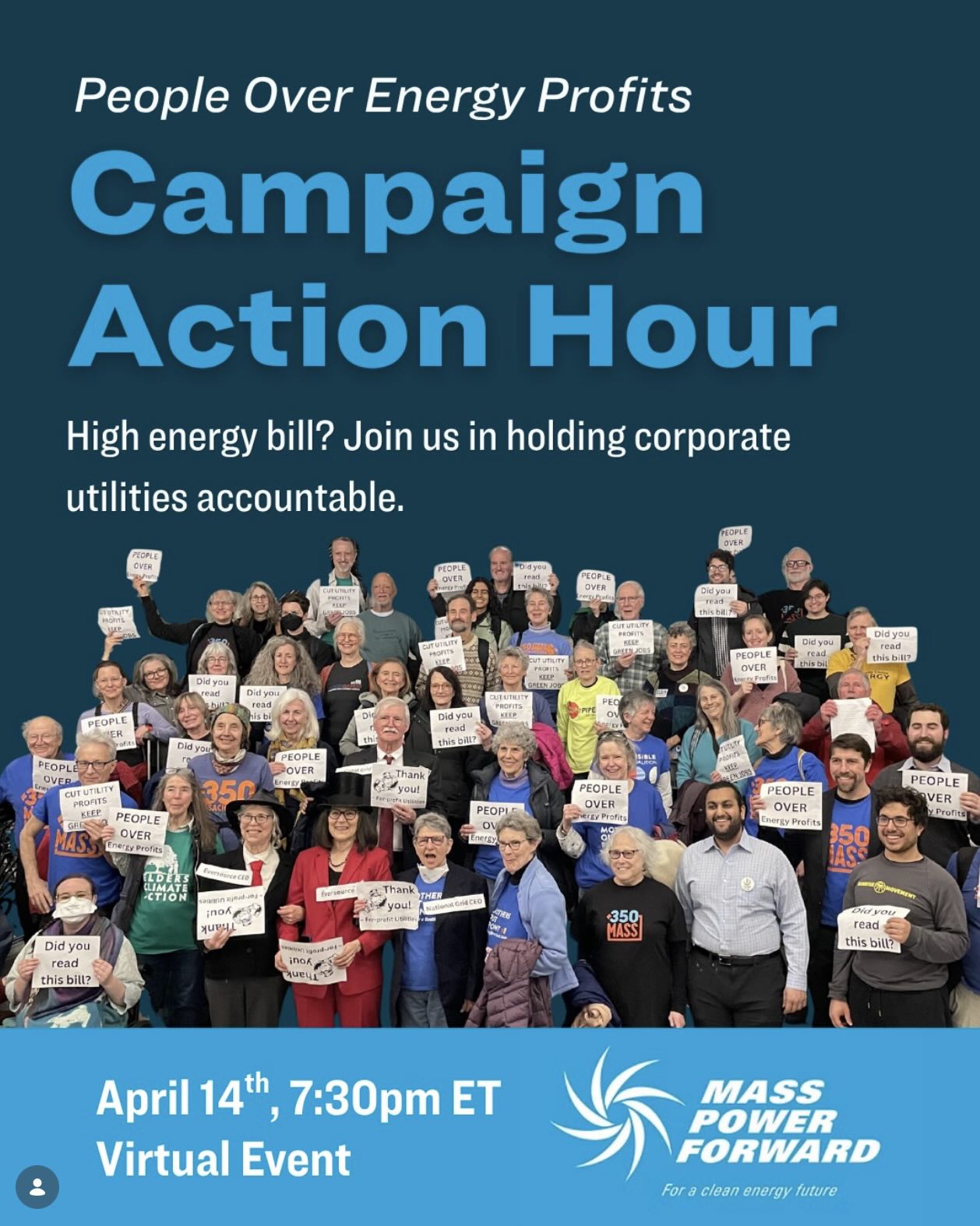
Sick of breaking the bank on high utility bills while utility companies rake in record profits? Join our friends at Mass Power Forward for an action hour this week!
TAKE ACTION: PEOPLE OVER PROFITS>>
---
Thanks for reading! Until next week.
In solidarity,
Scotia
Scotia Hille (she/her)
Executive Director, Act on Mass