Good morning!
April showers are trickling their way into the ground, lending moisture and sustenance to future May flowers. Despite a few cold days that sneak in to remind us we live in New England, summer seems to be right around the corner.
For those of us that follow the Massachusetts state legislature, that timeline also signals something else: the impending end of the 194th session. Formal sessions will conclude on July 31st, which is now just four months away. Those four months also coincide with House and Senate debates on the annual budget, which usually takes up a lot of time and energy.
Senate President Karen Spilka spoke to reporters on Monday (paywall) about the Senate’s “pre-budget” priorities, naming three pieces of legislation the Senate will “hopefully” address by mid-May. These bills were the energy affordability bill, the PROTECT Act on immigration, and the $1.8 billion supplemental budget, which have all been passed by the House in recent months.
Record scratch. We’re more than a full year into this two-year legislative session, with little substantial policy change to show for it, and the Senate expects to get three major bills done by mid-May? Only two of which are actually policy bills? Leaving two months for… uh…. everything else of importance to a state of 7 million people?
What's more, even if the Senate takes up these issues in the next two months, they will not immediately become law. The Senate will likely pass slightly different versions of these bills than what was passed by the House. When this happens, the bills are sent to a “conference committee,” where three members of each chamber will be assigned to negotiate a final version of the bill between closed doors. This undemocratic process can add months. If we’re lucky, we might see final action on our state immigration law or energy affordability in late summer. For all the other priorities we’re waiting on… who knows?
Meanwhile, ICE is still endangering our communities. Residents in East Boston were reportedly woken up at 6 A.M. Tuesday by loud percussion grenades launched by DHS as part of an immigration raid. On Wednesday, ICE agents in unmarked vehicles engaged in a high-speed car chase through Milford and Medway, resulting in a car crash. Our legislature has had almost 1.5 years to act on immigration and protect our communities. At this crucial moment, the glacial pace of policymaking on Beacon Hill is failing us.
If you’re frustrated with this process, I’ve got another pitch for you: put your frustration to action with a letter-to-the-editor or op-ed in your local newspaper! Act on Mass is hosting an op-ed workshop on April 16th at 6:30 p.m. to practice these skills. Join us!
---
State House Scoop
House reps use loophole to avoid public vote against state house staff union
Democratic reps in Massachusetts love to tout their pro-union credentials, soliciting endorsements from labor unions, attending union breakfasts, and waxing poetic about the importance of organized labor to our democracy. Yet, when it comes to their own employees at the state legislature, they have once again shown themselves to be hostile to the rights of workers.
Legislative staff have spent years organizing for the right to collectively bargain for better working conditions. As we’ve said before at Act on Mass, state house staff are the backbone of our state legislature, and crucial to our vision of an effective, transparent, and accountable legislature. Staff provide essential constituent services, do research on legislation, and support rank-and-file representatives as they navigate the hierarchical power structures of the building.
Yet, in a state house that values the accumulation of power over good policy outcomes, state house staffers too often fall at the bottom of the totem pole, overworked and underpaid. In one of the richest states in the country, 1 in 5 legislative employees report being food insecure. More than half of surveyed legislative staff plan to leave the legislature in the next two years, causing high turnover rates that disrupt the accumulation of knowledge.
In 2022, Senate staffers organized enough members to form a union, but legislative leadership refused to recognize their union, arguing that it was illegal under state law. This makes the state house one of the only workplaces in the state where it is illegal for employees to collectively bargain—because their bosses write the law! Staffers have organized behind bills to change this law for the last several sessions, only to see those bills sent to study with no vote.
This year saw the introduction of public committee votes after years of organizing by Act on Mass and our allies. This change allowed for additional scrutiny around the staff union bill, An Act relative to collective bargaining rights for legislative employees (H.2093 / S.1343). Would legislators really vote openly against the labor rights of their own employees?
In the last few weeks, that question was answered: no.
Meaning, they wouldn’t vote at all.
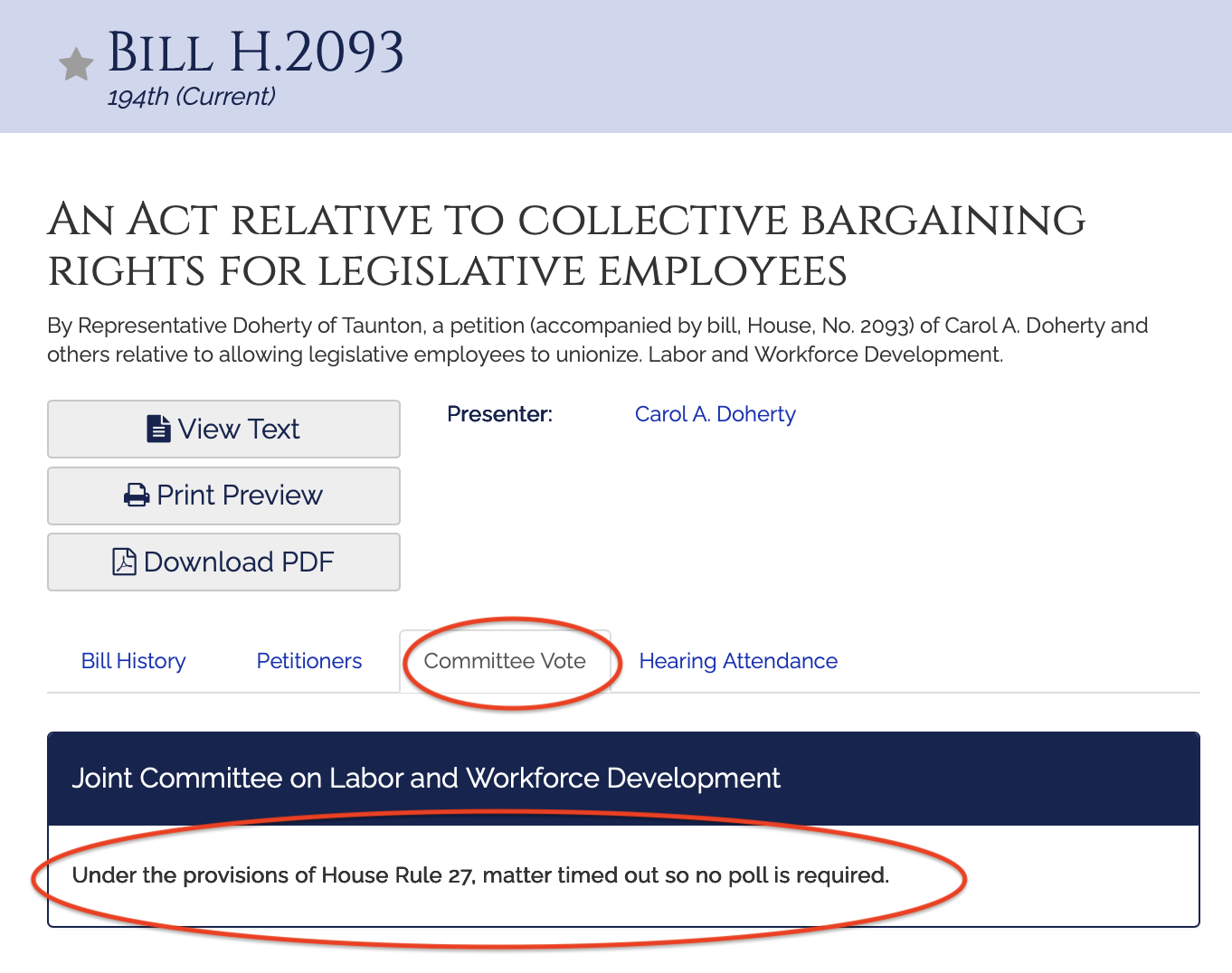
House members of the Joint Committee on Labor and Workforce used a procedural loophole to avoid taking a public vote on the matter. Just like previous sessions, it was “sent to study” (a.k.a. killed) without a vote.
Act on Mass warned about this loophole when the new rules were finalized last year. When the House voted to make committee votes public, they also instituted a new “rolling deadline” for bill decisions. Each House bill was given an automatic deadline of 60 days from its hearing date for the committee to report on the bill, with an optional 30-day extension—ostensibly to increase legislative efficiency. However, they also changed the rule language to clarify that bills which did not receive a report by their deadline would be automatically “sent to study.” We wrote at the time: “we are concerned, therefore, that lawmakers might use this as a loophole for anything they don't want to take a public position on– just wait out the deadline and they're spared an uncomfortable vote.”
Unfortunately, our concerns were well-founded. On the state house staff union bill, we saw this in practice:
The existence of this loophole is why our push for transparency and accountability continues. Our win on public committee votes was significant, and has allowed the public greater scrutiny over bills moving forward, resulting in better policy outcomes. However, our legislators are still finding ways to avoid showing their constituents where they really stand. It’s up to us to continue holding them accountable with the new tools in our transparency toolbox.
Here’s what we know: House members of the Labor and Workforce Development committee failed to push for a public vote on an issue impacting the people that keep their workplace running every day. If your rep is on that committee, send them an email! Can they explain why the committee decided not to vote on this bill? Did they advocate behind the scenes? How would they have voted?
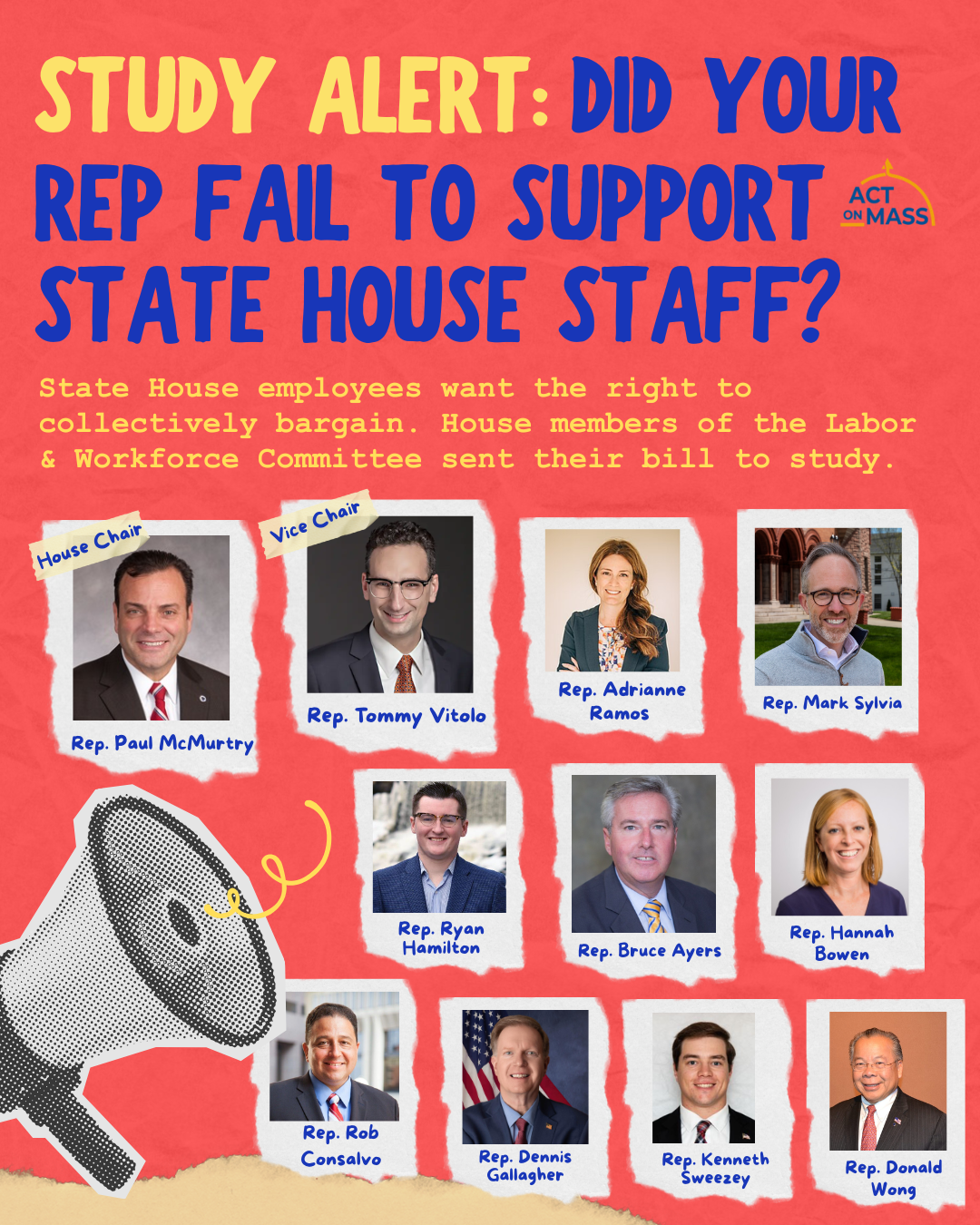
Note: of all the representatives on this committee, only Rep. Dennis Gallagher was a co-sponsor of H.2093.
If your rep is not on the committee, reach out to them to ask their position on this issue. Do they support the right of legislative staff to decide for themselves whether or not to unionize? If this issue had been brought to the floor, how would they have voted?
The Senate version of the bill (S.1343) is still in its committee, with the reporting deadline extended to July 31st, 2026—the very last day of session. Contact your senator to urge them to co-sponsor the Senate version and advocate for its passage through committee.
And if you’re hesitating, just think: the first person to read your email or listen to your voicemail is likely to be a legislative staffer. Their bosses just decided to continue to deny their labor rights, without a vote. Your outreach has two impacts: telling your rep you're paying attention, and showing solidarity to state house staff. Personalize our email form to reach out today!
TELL YOUR REP: STAND UP FOR LEGISLATIVE STAFF>>
---
New guest blog post: Norma Wassel
A guest blog post by Norma Wassel, a member of the Women and Incarceration Project at the Center for Women’s Health and Human Rights and the Cambridge Committee for Transparency and Accountability.
Lack of Transparency and Accountability in State Spending by Sheriffs and Department of Correction
Would any of your employers give you an approved budget for the year AND also a blank check? If you told them later that you needed more money, would they later sign the check without even asking what it was for? This is exactly what our state legislature has done for the 14 sheriffs in Massachusetts for many years as noted in two recent Boston Globe editorials, “This is the year to reign in free-spending sheriffs” and “Massachusetts sheriffs own up to empire building as budget cuts loom.”
Unlike other states with broader county-level governments, the responsibilities of sheriffs in Massachusetts are relatively limited.They are for county jails and departments of correction, including providing for the needs of incarcerated people. Their budgets are supplied by the state legislature and have come into scrutiny in recent months, resulting in an investigation by the Office of the Inspector General.
The Office of the Inspector General’s preliminary report “found that the sheriffs’ budget process has become opaque, chaotic and deeply flawed.” Most significantly the Inspector General also noted that “there is a lack of transparency and accountability in the supplemental budgeting reportprocess.” In essence, the sheriff’s offices regularly overspend their allocated annual budgets with the understanding that the legislature will cover cost overruns through “supplemental budgets” passed outside the regular budget process, without hearings and with few if any line items. For years, our legislature continued this routine funding process even as the jail population has decreased...
Visit Act on Mass' website to read the full blog post!
---
Lily's Lowdown: The State House’s gambling “gold mine” at the expense of everyone else
With March Madness on center stage, so too is sports betting, the rise of which has simultaneously brought an onslaught of revenue to the commonwealth and opened up the world of sports consumption to gambling directly on the sporting events they watch. Not only can consumers wager money on the outcomes of games using just a few clicks on their cell phone, but companies like DraftKings and Fanduel have transformed legal gambling with the introduction of a seemingly endless selection of “prop bets.” These are bets on things like the number of free throws or assists a particular player might make, the point spread of a game, and other individual wagers that aren’t necessarily related to the outcome of the game.
In Massachusetts, the marketplace of gambling has shifted rapidly over the last 15 years, and has proven to be, in the words of House Speaker Ron Mariano, a “gold mine.” The legalization of both casino gambling and online sports betting have both emerged quite recently in Massachusetts, by actions of the legislature in 2011 and 2022 respectively. Legislators defended these legalizations by pointing to increased tax revenue for the state and the ability to help problem gamblers through state programs.
However, the convenience of being able to open your phone and—with no more than a few taps—wager a number of bets as easily as you might send a text message raises new questions about the rush to legalize. Studies are already pointing toward a correlation between the legalization of online sports betting and the rise of problem-gambling.
This shifting landscape of legalized gambling has also seen a troubling trend of exploitation. Recent comprehensive reporting from the Boston Globe found that Encore, Foxwoods, and Mohegan Sun casinos deliberately prey on people of Asian descent, not only by making the casino accessible via frequent shuttles, but also by drawing them in with targeted marketing. Illicit loan sharks are ostensibly allowed to openly operate outside casino facilities, often offering loans well into the six figures. Despite persistent requests to audit casinos’ marketing to Asian demographics, the Massachusetts Gaming Commission has failed to do so, amidst concerns about the commission's own oversight failures.
This is only one facet of the predatory nature of the industry as a whole. The targeting of vulnerable people has only been magnified by the legalization of sports betting. DraftKings, the Boston-based sports gambling company, spent thousands to lobby the State House to influence the legalization of sports betting here in Massachusetts. The company is also looking toward breaking into the prediction market space, where it would join apps like Kalshi and Polymarket.
The lobbying efforts of DraftKings, bolstered by enthusiasm from State House leadership, led to the legalization of sports betting both in-person and online, through apps like DraftKings and Fanduel. The ease with which bettors can wager on these platforms makes people particularly susceptible to becoming entrapped in gambling addiction. In fact, getting hooked without actually making money from wagering is largely by design. The Legislature is currently considering limitations on the rules instituted by sportsbooks that intentionally shut off the bettors whose wagers are winning, while letting bettors with losing wagers continue to play. WBUR reportingfrom December 2025 tells the stories of the many young people in the Commonwealth who have been funneled into the sports betting to problem-gambling pipeline.
Communities all over the commonwealth are paying the price of casinos without reaping the benefits of the revenue generated from them. While casinos rake in billions in profits, communities are the ones paying the price. Since 2023, municipalities, already facing evaporating funding, saw revenues from casinos stagnate in the years since the legalization of online sports betting. Even as these communities bear the social costs of casinos, like elevated rates of problem-gambling and crime. Indeed, the legalization of sports betting has brought a significant revenue spike to the state— a 155% increase from gambling alone, as reported by the UMass Donahue Institute. Yet, instead of putting casino revenue back into the Community Mitigation Fund (CMF), the Legislature has chosen to redirect the money to cover budget gaps, even as municipalities struggle with dried-up funding.
The Legislature’s series of failures on gambling has left communities to grapple with rising incidence of problem-gambling without reaping any of the benefits of this so-called “gold mine” that should have enriched these very communities. In this way, the revenue raked in from the state through taxes on gambling betting is a tax on the victims of predatory exploitation by both casinos and sports betting platforms, all while legislative leaders line the pockets of their lobbyist friends.
---
Missed a Scoop or two? You can find a full archive of all past Saturday Scoops on our blog.
---
What else we're reading this week
Good reporting from this week in MA politics!
- When utilities ask to raise rates, customers pay the legal fees. A bill in Mass. would change that by Miriam Wasser, WBUR
- Endless waitlists: A look at the growing primary care crisis in the Berkshires By Talia Lissauer, The Berkshire Eagle
- Climate reckoning: Mass. communities stare down the prospect — and complications — of a retreat from rising waters by Jordan Wolman for Commonwealth Beacon
- OPINION: Time for new Dem leadership on Beacon Hill by Matt Chilliak in Boston Herald
---
Take Action

Let your voice be heard - join AOM's Letter to the Editor Workshop! - April 16th, 6:30 p.m.
Our workshop will cover best practices for drafting, editing, and pitching your LTE or op-ed using the push for stipend reform at the state legislature as an example. Whether you write about stipend reform or an issue of your choice, come review with us!
SIGN UP FOR OUR LTE WORKSHOP>>

Our legislators need to stop stalling and take action to protect us from ICE. Please use our email form to contact your representative today.
TELL YOUR REP: CO-SPONSOR PROTECT ACT>>
Advocate for Medicare for All this week! - Today 4/4 and Tuesday 4/7!

Our allies at MassCare are holding two actions this week to push the legislature and the Governor to take action on Medicare for All!
JOIN ALLIES TO SAY: WE NEED M4A>>
---
Thanks for reading! Until next week.
In solidarity,
Scotia
Scotia Hille (she/her)
Executive Director, Act on Mass