
Happy "No Kings" Day!
Sunshine Week closed last week with a bang. I mean, a big bang.
The Society of Professional Journalists (SPJ) announced Massachusetts as the winner of its “Black Hole Award” last week. The award is an “annual dishonor recognizing government entities that demonstrate a troubling lack of transparency and disregard for the public’s right to know.” You’re telling me, SPJ!
The Society singled out Massachusetts for its broad exemptions to public records law for the governor’s office, legislature, and judiciary, as well as the considerable barriers and loopholes to public records for state entities that are subject. I'll quote SPJ’s president: "The public should not have to fight, wait or pay exorbitant costs to understand how their government operates. Transparency delayed or denied is accountability denied — and that undermines the very foundation of public trust.”
Act on Mass is supporting a ballot question this year to subject the state legislature and governor’s office to public records law. If all goes well, we can hope that the Black Hole Award will pass to another state by next year's Sunshine Week!
“Dishonors” like these are one example of how members of the press can use their power of the pen to hold governments accountable. The public also has tools to call attention to abuses of power like this. We’re hosting an upcoming workshop on one of these: writing Letters to the Editor and Op-eds.
Our LTE / Op-Ed workshop has been one of our most popular, and we’re excited to host another one on April 16th at 6:30 P.M. on Zoom! If you want to get the word out in your community about legislative dysfunction, the “Black Hole Award,” this year's ballot questions, or another issue of your choice but aren’t sure where to start, sign up for our workshop!
WRITE AN LTE OR OP-ED WITH ACT ON MASS>>
---
Lily's Lowdown: PROTECT Act Passes the House
Even amidst the flurry of bad news, there is a glimmer of hope coming from the State House this week—the House voted 134-21 to pass the PROTECT Act after advancing out of House Ways and Means with a 25-0 vote on Tuesday. The bill now heads to the Senate for consideration.
As a quick reminder, the PROTECT Act is a product of the Safe Communities Act, which was first filed during Trump’s first term and has been stalled in the State House since. It sought to formally restrict local and state law enforcement from collaborating with ICE, including by ending the Department of Corrections 287(g) collaboration agreement. In the past, particularly during the Obama era, the deputization of local law enforcement through things like the issuance of ICE detainers—requests by ICE to hold a noncitizen in custody—have been essential to ICE’s operations. Similar legislation limiting local law enforcement collaboration with federal immigration enforcement is already in effect in several other blue states.
In a renewed effort to keep immigrant communities safer during an ICE surge that has terrorized communities from Maine to Minnesota, members of the commonwealth’s Black and Latino Caucus introduced the PROTECT Act this year. This bill would ban warrantless civil arrests by ICE in MA courthouses, ban future—but not eliminate existing—local and state 287(g) agreements, require that employers give employees written notice if they receive an I-9 Audit (inquiry about immigration status), and restrict ICE activity in designated “sensitive locations,” among other measures. As we wrote then, this action by the Black and Latino Caucus showed the importance of “horizontal organizing” between colleagues in a legislature that is too often top-down.
PROTECT passed with three major amendments. For one, an amendment was passed that clarifies that the bill applies to sheriffs offices, as Bristol, Barnstable, and Plymouth counties have previously held 287(g) agreements they declined to renew. The amended bill also requires that the Governor provides multilingual guidance for school districts outlining how to handle interactions with ICE regarding civil immigration enforcement. It also expedites the visa process for those with dependents approaching the age cap for dependent status.
It’s not time to sing anyone’s praises just yet—for one thing, the bill’s glaring deficiency is its failure to end the State Department of Corrections (DOC) 287(g) agreement, which enables ICE operations by using state resources to facilitate federal immigration enforcement. This agreement makes it so that DOC facilities are enlisted in the detention of migrants across the state. Governor Maura Healey has reiterated she is vehemently opposed to ending the DOC’s 287(g) even though Massachusetts is the only blue state with one of these still in place.
Plus, in the 14 months since Trump took office again, two separate monthlong ICE surges in the commonwealth have resulted in the detention of thousands of people across the state, many of whom have been deprived of due process. For example, the story of this Waltham man who was deported to El Salvador without a trial. The human costs of legislative inaction and delay are significant.
Make no mistake: this bill passing the House is a huge victory: for the Black and Latino Caucus, for the immigrant rights groups that have been fighting for state action on immigration since 2013, and for the communities who will have their rights further protected once this legislation is finalized. Still, this victory is bittersweet, thinking of all the MA residents who could still be here if the legislature had acted years ago.
---
State House Scoop
House Minority leader Brad Jones to retire, upending paid opposition
This week, MA House Minority Leader Brad Jones announced that he will not be seeking re-election. This is the end of an era for the House Republican caucus, of which Jones has been a member since 1994 and Minority Leader since 2002.
Discussion of Jones’ departure has centered around the relatively moderate stance he struck in the state house, which members of his party occasionally criticized as conciliatory to the Democratic supermajority. Upon the announcement of his retirement, he received high praise from Democratic Speaker Ron Mariano, who released a statement calling Jones a “thoughtful and pragmatic leader who preferred compromise over obstructionism.”
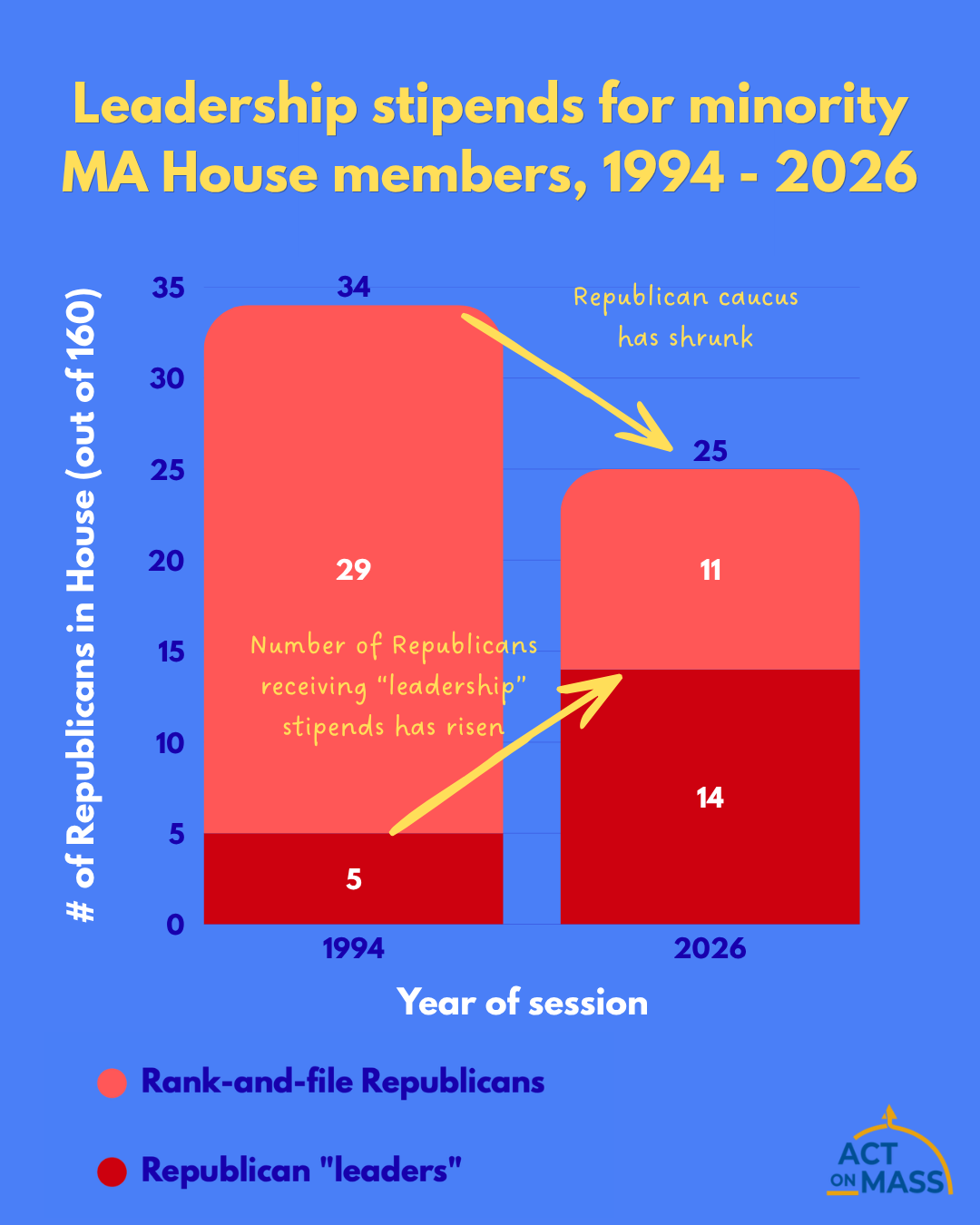
Since Rep. Jones was first elected in 1994, the Republican caucus has shrunk from 34 members to just 25 this year—out of 160 House seats. His tenure has also seen a massive expansion of the system of leadership stipends on top of member pay, which has shifted incentives for the minority party.
When Rep. Jones entered office in 1994, there were only five members of the 34-member House Republican caucus who received extra pay for leadership positions. The highest of these stipends was for the minority leader, who received additional pay of $22,500 per year— roughly a 48% boost to their annual salary. 29 Republican reps made the base salary, which at the time was $46,410.
Over the years, leadership has added additional carveouts to the statute and increased the size of stipends, to the benefit of Democrats and Republicans alike. In 2005, the legislature added an “s” on the end of “third assistant floor leader,” allowing for two (!) third assistant minority leaders, who each pull a stipend of $52,339. Other changes added stipends for “ranking minority” House members of seemingly random Joint Committees. In MA, “ranking minority” refers to the highest-ranking Republican member of a given committee.
(Quick sidebar: interestingly, no extra stipends are given to ranking minority Senate members of those same committees. This may be because they're already getting extra pay: all five Republican senators are considered “assistant minority leaders” and receive leadership stipends of at least $52,339 per year for their tough work keeping the, uh, 5-person Republican caucus in line. No need to add committee carveouts to give them extra pay. Gee, you’d almost think the extra stipends actually have nothing to do with their work…)
With the additional carveouts and pay increases, the number of House Republican members receiving leadership stipends is now 14 out of 25. Only 11 Republicans are stuck at the base salary of $82,046. The highest minority stipend goes to Brad Jones as minority leader, totaling $89,724 extra for his position—a whopping 109% increase on his salary. Jones now makes more than twice as much as rank-and-file Republicans and Democrats.
To put this in context, there are just three members of the U.S. House of Representatives who receive more pay than rank-and-file members: the Speaker of the House, the majority leader, and the minority leader. The highest boost goes to the Speaker of the House, who receives a salary just 28% more than rank-and-file members. These leaders manage caucuses of 217 Republicans and 214 Democrats. Yet, our 25-person minority party in Massachusetts “needs” a minority leader, four assistant minority leaders, and nine committee leaders to govern itself. Hm.
The stipends have featured in discourse within the Republican caucus itself. Last year, Republican Rep. Marc Lombardo mounted an unsuccessful challenge to Jones as minority leader. He accused Jones of avoiding conflict with Democrats, saying that Jones had a strategy of “taking crumbs off the table in exchange for parking spots and stipends.” (Speaker Ron Mariano assigns the parking spots in the House garage, and has been known to distribute choice spots to favored members).
Votes by the MA House Republican caucus do reflect an interesting pattern: Republican leaders vote with Democratic leadership more often than rank-and-file Republicans. During the recent energy debate, Leader Jones’ only speech was in support of a consolidated amendment written by House Democratic leaders. Despite the fact that the majority of Republicans get leadership pay, rank-and-file Republicans made more speeches opposing Democratic positions in that debate and spoke for longer than their stipended counterparts. Just this week, Rep. Jones was one of four Republican members to support the PROTECT Act to reform our state immigration law, which passed the House on Thursday.
We know that legislative stipends are wielded by House Democratic leadership as a tool of conformity to keep Democratic reps in line. It’s not too hard to follow that same logic for the 56% of House Republicans who now receive leadership pay.
All the pay increases and additional stipends for minority members were added to the statute by Democratic leadership, which has tight control over the votes of the supermajority Democratic caucus. These extra stipends for Republicans were a courtesy, likely to reduce Republican opposition as House leaders expanded the number of Democratic stipends. It also means the stipends can be removed if Democratic leadership so chooses.
Whether this is explicit or not, the message can be plainly read: don’t make our job too hard, and we’ll keep boosting pay for your members. Indeed, Commonwealth Beacon notes that “under Jones, House Republicans have at times pulled the more aggressive levers of government available to them,” like wielding parliamentary procedure, “but that kind of approach has been more the exception than the rule.”
As a progressive, I’m not too upset about the few Republicans in our state house having a quieter voice. There's a reason their party does not win a majority in our blue state. When I see the terrifying reactionary policies being passed in states with Republican supermajorities, I’m grateful to live in MA. Republicans here should have to “work with the majority” to get things done.
However, as a democracy advocate, I know that public opposition is essential to a healthy democracy. Whether you agree with them politically or not, an active opposition party helps to hold the majority leadership accountable, through tactics like forcing roll call votes, preventing votes from being done without a quorum, etc. And as we discussed a few weeks ago, our Democratic leaders are determined to suppress any and all public dissent within the Democratic caucus: where the real political divide lies in our political landscape. If the Republican caucus is also being plied with cushy leadership jobs to keep their oppositional tactics to a minimum, House Democratic leaders only accumulate more power.
Plus, in a legislature representing 7 million people, there will always be representatives proposing ideas we personally disagree with. I would rather see those ideas be defeated in a public vote, stating openly who we are as a society, than be bought off (or worse, incorporated) behind closed doors.
It’s all a great argument for why we need to pass stipend reform at the ballot. House Democratic leaders shouldn’t be able to dole out additional pay for select members of the opposition party. Democrats and Republicans alike should have no reason to fear impacts to their livelihoods—or those of their party members—by openly challenging leadership. In the spirit of No Kings today, I'll say: no kings in the state house either!
The initiative is still working its way through the ballot process. If the legislature decides not to pass stipend reform themselves (spoiler alert: they won’t), we will need to gather a further 12,000 signatures in May and June and we’ll need all the help we can get. If you haven’t signed up with the campaign yet, please do so today.
SIGN UP TO PITCH IN FOR STIPEND REFORM>>
---
Missed a Scoop or two? You can find a full archive of all past Saturday Scoops on our blog.
---
What else we're reading this week
Good reporting from this week in MA politics!
- Act on Mass featured! Advocates and lawmakers at odds over transparency ballot questions by Jamie Perkins for New Bedford Light
- Inside an alarming year for Mass. prisons: Spate of suicides forces reckoning By Hadley Barndollar and Greta Jochem for MassLive
- 72% of Voters Demanded an Audit. The AG Is Blocking It—and Lying About Whyby Aaron Singer for Shadows on the Hill
- **How casinos in New England are exploiting Asian communities for profit (paywall)**By Chris Serres, Danny McDonald, Mable Chan, and Esme Jimenez for Boston Globe
- Frustration grows over state’s K-12 school funding approach by Sam Drysdale for SHNS (in Greenfield Recorder)
---
Take Action

Let your voice be heard - join AOM's Letter to the Editor Workshop! - April 16th, 6:30 p.m.
Our workshop will cover best practices for drafting, editing, and pitching your LTE or op-ed using the push for stipend reform at the state legislature as an example. Whether you write about stipend reform or an issue of your choice, come review with us!
SIGN UP FOR OUR LTE WORKSHOP>>

Our legislators need to stop stalling and take action to protect us from ICE. Please use our email form to contact your representative today.
TELL YOUR REP: CO-SPONSOR PROTECT ACT>>
Next week: join the "Save Our State" hearing and protests against harmful tax cuts! - March 30th, Boston

On Monday March 30th, the legislature will be holding a hearing on two tax-related ballot questions that would dramatically slash our state's revenue, at a time that budgets are already squeezed by federal cuts and rising inflation. You can sign up to testify or submit written testimony opposing the cuts.
Before the hearing Monday, Raise Up Mass is leading protests in Boston at the financial institutions that are underwriting the ballot question. Learn more and sign up at the link below.
JOIN THE 'SAVE OUR STATE' PROTESTS>>
---
Thanks for reading! Hope you're resting up from a joyful day of protesting with your neighbors and allies. Onwards.
In solidarity,
Scotia
Scotia Hille (she/her)
Executive Director, Act on Mass