Happy Sunshine Week!
This week, good government groups across the country spread awareness about the importance of “sunshine” laws that bring government activities into view of the public. Naturally, it’s a big week for us at Act on Mass!
On Tuesday, we joined with supporters to testify at the public hearing on the stipend reform ballot petition, telling legislative leaders directly how their “loyalty pay” system disrupts legislative progress. Three former legislators testified (paywall) to their experience seeing the expanding stipend system transform the legislature from a deliberative body to a top-down black box where the opinions of rank-and-file members are completely sidelined.
Even as the sitting lawmakers got a little testy, several members of the public delivered moving public testimony in favor a more equitable and just system of legislator pay. I was really proud of our movement.
Then, on Thursday, we hosted our audit webinar with former appellate lawyer Jeanne Kempthorne! We were able to dig deep into some of the murky legal concepts surrounding the delayed audit, with great questions from attendees. If you weren’t able to make it, you can find a recording on our YouTube.
Here's hoping your week is full of sunshine! ☀️
---
State House Scoop
We’re currently in the middle of annual budget season on Beacon Hill. As we discussed last month, Governor Healey’s proposed $62 billion Fiscal Year 2027 (FY2027) budget is currently sitting in House Ways & Means, the first stop in the legislature for all budget bills. This budget funds all the entities of the state government and is finalized with an annual process that takes place every year from roughly January through July.
In the last few years, it has become more common for our legislature to also pass “supplemental budgets,” which are smaller spending packages to fill particular gaps or allocate additional funds, outside of the traditional annual budget. In Fiscal Year 2025 (FY2025), supplemental budgets ended up adding an additional 10.9%, or $6.3 billion, to the budget originally approved in 2024. The result is that the annual state budget has become a mere “starting point” for spending.
As good government advocates, we have plenty of grievances with the “traditional” budget process in our state. Although legislators host hearings all over the state on the annual budget, comment from the general public is only allowed at one hearing. Leadership controls the text of the budget and the amendment process. Consolidated amendments obscure outcomes from the public.
However, the shady process behind supplemental budgets manages to make the annual budget look like a transparent, sunny alternative. Let’s talk through an example from this week.
This week’s supplemental budget spotlights tension between municipal funding and leadership control
On January 29th, 2026, shortly after filing her annual budget proposal, Governor Healey also filed a “supplemental budget” proposal (H.5033) with the legislature. This supplemental budget proposed to allocate $1.15 billion in surplus revenue collected through the Fair Share amendment, which must be used for transportation and education spending. Translation: asking millionaires to pay their fair share in taxes has been so successful that we keep ending up with extra, unanticipated money to spend later on transportation and education.
The downside: because leadership has tight control over the redrafting of supplemental budgets in Ways & Means AND a vice grip on the amendment process, this additional spending has become ripe for exploitation via local earmarks to favored districts. For example, on a supplemental budget to allocate surplus Fair Share funds last year, the Speaker added a last-minute “stealth amendment” to allocate $25 million (!) in “transportation” spending for a single parking garage in his district.
Back to the bill at hand. Since January, Governor Healey’s supplemental budget proposal has sat in House Ways & Means. Like most supplemental budgets, it never had a public hearing. Then, on Tuesday, a new version was suddenly voted out by Ways & Means members. The new bill (H.5264) totaled $1.8 billion of mostly Fair Share funds, with the bulk of transportation funding ($740 million) going to the MBTA and education spending split up between a longer list of priorities. It also contained $300 million in General Fund dollars to fill a gap at the insurance entity for state employees, among other priorities.
The 31-page bill was scheduled for a vote of the full House on Wednesday, less than 24 hours later. In the short window between Tuesday and Wednesday, representatives filed 456 amendments to the bill, almost all of which were earmarks for local projects.
Many of our cities and towns are dealing with municipal revenue crises. Our state law restricts municipalities’ ability to pass local taxes, leaving our towns and cities disproportionately reliant on property taxes and direct state aid. Yet, Proposition 2.5 severely limits flexibility on property taxes, and direct state aid to municipalities has stagnated over the last few years. Amid rising inflation, these economic conditions have been described as a “perfect storm” of fiscal pressure for municipalities. Just while writing this Scoop, I got another Globe notification: “‘There are just no dollars’: From zoo closures to library cuts, Mass. towns confront deepening budget crisis.” Bottom line: everyone’s hometown could use a little extra money from the Fair Share pot.
In such dire circumstances, the extra Fair Share funding should be allocated in a transparent process that everyone can see and participate in, with priority to the highest-need districts. Instead, we got a 24-hour amendment bonanza, with the outcomes completely controlled by House leadership.
In a repeat of the opaque and confusing process that we explored for the recent energy bill, two massive “consolidated amendments” were used to dismiss and approve the 456 earmark amendments. Leadership wrote these “consolidated amendments” behind closed doors, with the fate of individual amendments unclear. They were approved with near-unanimous votes. As was the case for the energy bill, it’s hard to tell which amendments succeeded and which were “consolidated away.”
Well, for our sake, I tried. The House’s “education” consolidated amendment tacks on $37.4 million in earmark spending, while the “transportation” consolidated amendment adds $10.1 million. Most of the approved earmarks range between $20,000 to $200,000 and cover local projects for cities and towns or nonprofit organizations.
Some inequities in the local funding stand out. Assistant House Majority Leader Alice Peisch got all three of her proposed earmarks in the final version, totaling $650,000 for the town of Wellesley (population 29,550 with the third highest median income in the state!) Meanwhile, just $35,000 was earmarked for Lowell (pop. 115,554, ranked #295 for median income), which has no representatives that are members of leadership. The city with the lowest median income in the state, Springfield (pop. 155,929), was allocated $400,000.
Here’s another fun tidbit: of the individual earmarks granted to cities and towns, only four totaled $500,000. Two of these (!) were earmarked for Quincy (pop. 101,636), which is the hometown of Speaker Ron Mariano. A third went to Weymouth (pop. 53,743), which is represented by… Speaker Ron Mariano! In a time of municipal budget crisis, I guess it pays to be represented by the most powerful man in the Commonwealth.
Not just earmarks: municipal funding inconsistencies highlight legislature’s lack of professionalism
Quincy has also been in the news recently for another inconsistency in the state legislature's approach to municipal funding: the "gateway city" designation.
A “Gateway City” is an official state designation for mid-sized municipalities which have a median income and education attainment lower than the state average. Gateway cities, like Brockton, Chelsea, Fall River, Lowell, and Springfield , also tend to have high immigrant populations and are considered a “gateway” to the American dream. Under state law, they qualify for additional funding from the state for select programs.
In January, a Commonwealth Beacon investigation revealed that the state legislature had simply “not kept track” of which cities qualified for this additional funding. The list of official “Gateway Cities” has not been updated since 2013. Due to demographic changes, Methuen, Salem, and Quincy no longer qualify under the official criteria for gateway status. Yet, they have continued to receive thousands in additional state aid and tax credits. Meanwhile, at least two municipalities now meet "gateway" status, but have not been added to the list.
What’s going on here? $1.8 billion in critical funds, given about as much public consideration as a new state awareness day? Important designations that determine eligibility for state aid left untouched for decades? Hard-won Fair Share dollars distributed, apparently, more by proximity to leadership than by need?
Like an onion, this issue has many layers: the peculiarities of state-local control in Massachusetts, the consolidation of power in leadership in our state house, a long history of corruption, patronage, and institutional racism, plus the “squeaky wheel gets the grease” mentality that privileges already-privileged districts — I could go on.
At its heart is another way that Massachusetts’ state legislature distinguishes itself from other states. We are the only state in the entire country which does not have an independent research or fiscal analysis bureau to provide an unbiased source of information about bills. Instead, unlike our national congress and the legislatures of 49 other states (plus DC!), research on bills in MA is “provided by the staff representing the leaders of each house of the General Court.” In other words, leadership decides which facts are convenient for lawmaking. There is no independent source of information or predictions about bill outcomes.
On issues like municipal funding, it is clear that the absence of an independent, professional source of information on the impact of legislation is only a harm to the public. When our formulas are outdated, needs go unmet. When there is no other criteria available to weigh the funding priorities of a district other than the relationship that that district’s representative has with House leadership, unsurprisingly, that is the criteria that is used.
That’s why we at Act on Mass will keep fighting for sunlight in our state legislature and keep holding our representatives accountable to produce high-quality, progressive legislation. It's why we need stipend reform, to lessen the control that leadership has over the livelihoods of reps and, thus, the flow of information and legislation. Once stipend reform is approved at the ballot this fall, a fully funded, independent legislative research bureau will be on our short list for new reforms.
---
Missed a Scoop or two? You can find a full archive of all past Saturday Scoops on our blog.
---
Immigration Spotlight
As the toll of the Trump administrations' violent immigration enforcement actions continue to be felt in Massachusetts and nationwide, we wanted to continue highlighting local stories of how this is impacting Bay Staters and share calls to action.
- Huge news!! -** Mass. House plans to vote on bill banning warrantless civil immigration arrests in courthouses** by Chris Van Buskirk for WBUR
- Healey, Campbell urge Massachusetts residents to report alleged ICE misconduct to state by Phil Tenser for WCVB
- ‘Climate of fear’: Student enrollment declining amid Trump’s immigration crackdown By Hallie Claflin for Commonwealth Beacon
An updated version of the PROTECT Act (H.5158) was voted on by the Joint Committee on Public Safety and Homeland Security this week. The full language of the bill has not been made public yet. We will follow up with more information as soon as we have it!
---
What else we're reading this week
Good reporting from this week in MA politics!
- **More than paychecks at stake in legislative stipend ballot question **by Chris Lisinski for Commonwealth Beacon
- Massachusetts Could Be the Next State to Give Abuse Survivors a Pathway Out of Prison by Victoria Law for Bolts Magazine
- Shifting politics around data centers scramble Healey AI push by Jordan Wolman for Commonwealth Beacon
- WMass is losing population; Does Beacon Hill have a plan to stop the region's slow drain? By Carrie Healy for New England Public Media
---
Take Action

Our legislators need to stop stalling and take action to protect us from ICE. Please use our email form to contact your representative today.
TELL YOUR REP: CO-SPONSOR PROTECT ACT>>
Act on Mass is hiring!
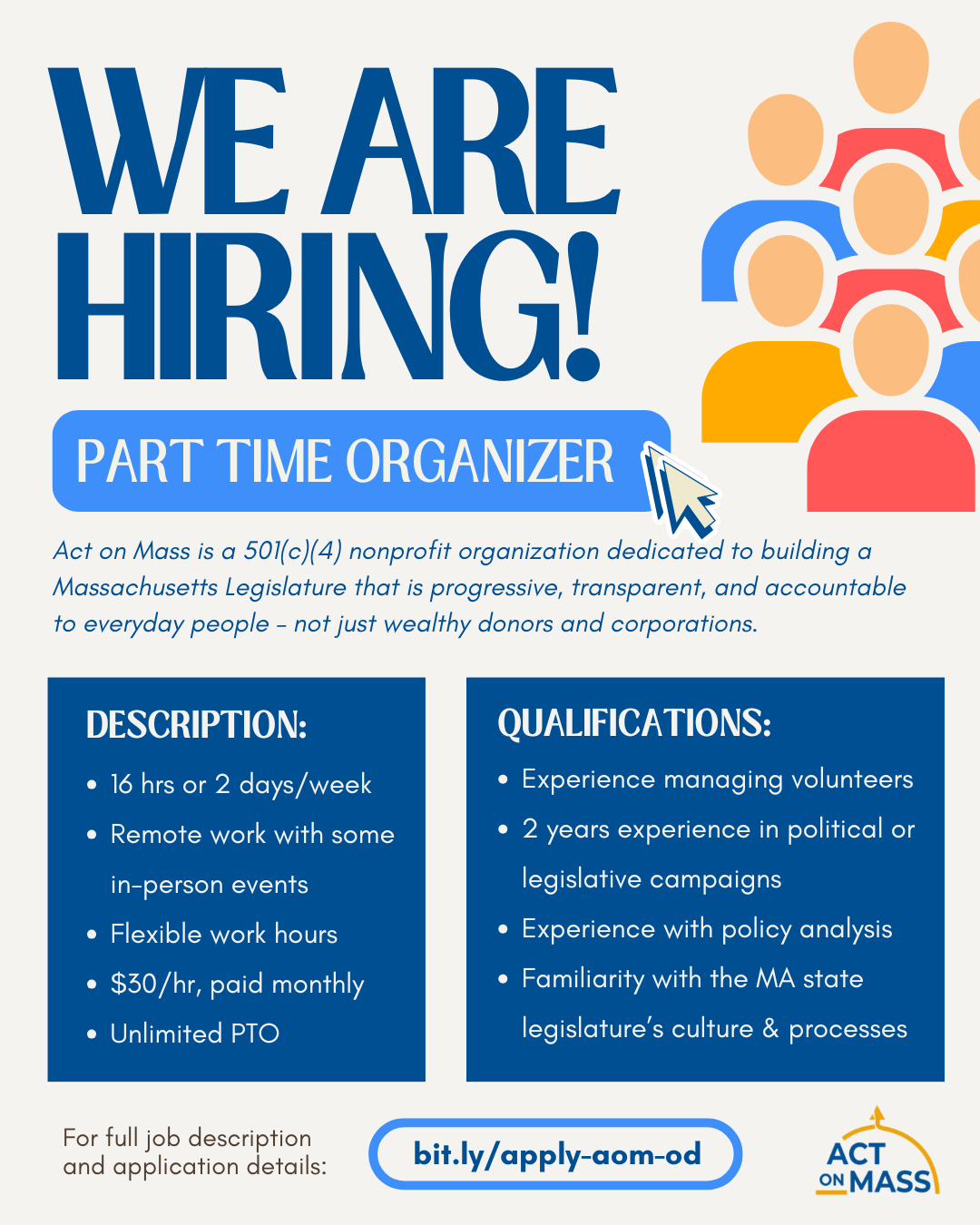
With elections on the horizon and a bunch more farmers markets to hit this summer, Act on Mass is hiring an organizing director! If you've got someone in mind for the role, send them our job description. :)
LEARN MORE ABOUT AOM'S ORGANIZER ROLE>>
---
Thanks for reading! As we turn away from winter and Sunshine Week comes to a close, I hope you enjoy some sunny spring rays this weekend!
In solidarity,
Scotia
Scotia Hille (she/her)
Executive Director, Act on Mass