
Happy Saturday,
In the 2024 election, Massachusetts had the least competitive state elections in the country. Only 1 in 10 incumbents in MA faced a primary challenge, and only 1 in 5 districts saw competition from the two major parties, putting us at a solid 50th out of 50 states in election competitiveness.
Although the data is not yet in for this year, there may be a shift in the tides afoot. Amid widespread frustration with incumbent Democrats for a perceived failure to adequately oppose President Trump, Massachusetts’ congressional delegation is facing a record number of primarychallengers. Meanwhile, a number of open seats in our state legislature have kicked off a few contested primaries, with others taking on incumbents directly. It’s a good year for it: after primary elections this week in Texas and North Carolina, the New York Times headline read “Primary Results Offer Warning Signs to Incumbents in Both Parties.”
Our legislature has not exactly endeared itself to voters since 2024. Legislators have failed to follow through on the legislative audit passed by voters and have stalled for months on a state response to Trump. Already, we are seeing these issues invoked by a new crop of legislative challengers, and can hope that more will follow them.
Contested elections are a crucial tool of accountability for our elected officials. When a rep has a challenger, they show up in their district more. They work harder to get policies passed this session, knowing that they need to show voters why they deserve to be sent back to Beacon Hill. When difficult votes come up, like last week’s vote on energy policy, they are more conscious of their constituents' concerns and more willing to stand up to leadership.
If you’re interested in seeing a contested race in your district, we have an incredible resource available to our progressive movement: Mass Alliance’ Grassroots Campaign Trainings.
Mass Alliance, a coalition of progressive organizations (including Act on Mass!), organizes these informative multi-day bootcamps to “teach you all you need to know to run and win a grassroots campaign for public office.” They have trainings running in Lynn, Quincy, and Springfield in the next few weekends. Whether you’re a candidate yourself, considering becoming one, or simply want to support grassroots campaigns in your area, consider signing up for one of their upcoming trainings!
ATTEND A MASS ALLIANCE TRAINING>>
---
State House Scoop
The Energy “Debate” Part 2
It’s been a week since the House voted to cut $1 billion from MassSave in the name of energy “affordability,” and the effects are still reverberating.
For one, with more than 48 hours to read the bill, we’ve seen some more expert analyses. MA Energy Efficiency Council co-chair Mary Wambui calculates that the $1 billion MassSave cut would generate between $7-12 in reduction of monthly energy bills for consumers, while decimating a program that is producing long-term cost savings for low-income households. Our good ol' Democratic supermajority: ransoming our energy future to save consumers the price of one (1) good sandwich per month while utility companies rake in billions in record profits.
Meanwhile, we at Act on Mass have had the time to pore through the 4.5 hours of recorded “debate” to draw some additional conclusions about the health of our state democracy.
For Part 1 of this series on the energy “debate,” concerning the content of the bill and the impacts of new transparency changes, read our Scoop from last week!
Consolidated away: how leadership control of the amendment process stifles debate
Let’s recap how this bill made it to the House floor. Since public pressure forced leadership to table a previous version of the bill in November, it has sat in House Ways & Means. House leadership hosted closed-door listening sessions with members in January. Then, last Tuesday, House leadership released the new version of the bill (H.5151) to committee members, who had 45 minutes to digest and vote on the 107-page bill. The bill, including the devastating $1 billion MassSave cut, proceeded to the House floor to be voted on by members just 48 hours later.
In the short timeline between release and vote, representatives filed 126 amendments to the bill. Indeed, for legislators who are not members of a bill’s initial committees, the amendment process on the House floor is their only formal opportunity to make changes to a bill before passage. Because the bill was a large omnibus bill, many of the amendments filed contained the language of other energy-related bills supported by representatives.
If our democratic system worked as intended, these amendments would each get their turn for consideration by the membership. Representatives would have adequate time to build up support among their colleagues, to give speeches on the floor for and against amendments. Ultimately, these amendments would be passed or rejected with public votes. This process would allow constituents to understand exactly which changes to the bill are being made, as well as to see and hear their representatives’ positions on specific issues.
Sadly, that is not how things work in the Massachusetts state house.
In the MA House, the passage and rejection of amendments is completely choreographed by House leadership. After all, 90% of the Democratic caucus votes in lockstep with the House Speaker. Instead of delivering their argument publicly to the whole House and allowing the amendment to be considered by their peers, legislators must appeal to either the Speaker directly or one of his lieutenants. Although the formal session to debate and vote on H.5151 was scheduled to begin at 11 am, members remained in a private caucus until 2:45 pm. Behind closed doors, leadership hammered out which amendments would live or die.
Leadership’s control of the amendment process is even more heightened when the House relies on “consolidated amendments” to pass and reject amendments, as was the case with last week’s energy bill. A consolidated amendment is when multiple amendments are combined into larger mega-amendments, which then receive an up-or-down vote from the body.
This process concentrates even more control in the hands of leadership, who write the “consolidated amendments.” This is true even for Republicans: the only speech given by House Minority Leader Brad Jones last week was in support of Consolidated Amendment B, in which he thanked Democratic leadership for including amendments his members had supported.
“Consolidation” also makes the fate of amendments extremely difficult for the public to track.
During last week’s energy debate, 15 out of 126 amendments were rejected outright. Most of the rejected amendments had been filed by Republicans, with two filed by progressive Democrats, including Amendment #113 to save MassSave. Three of the amendments were withdrawn by their filer. The remaining 108 amendments are marked as included in one of three consolidated amendments, which passed. It looks like this:
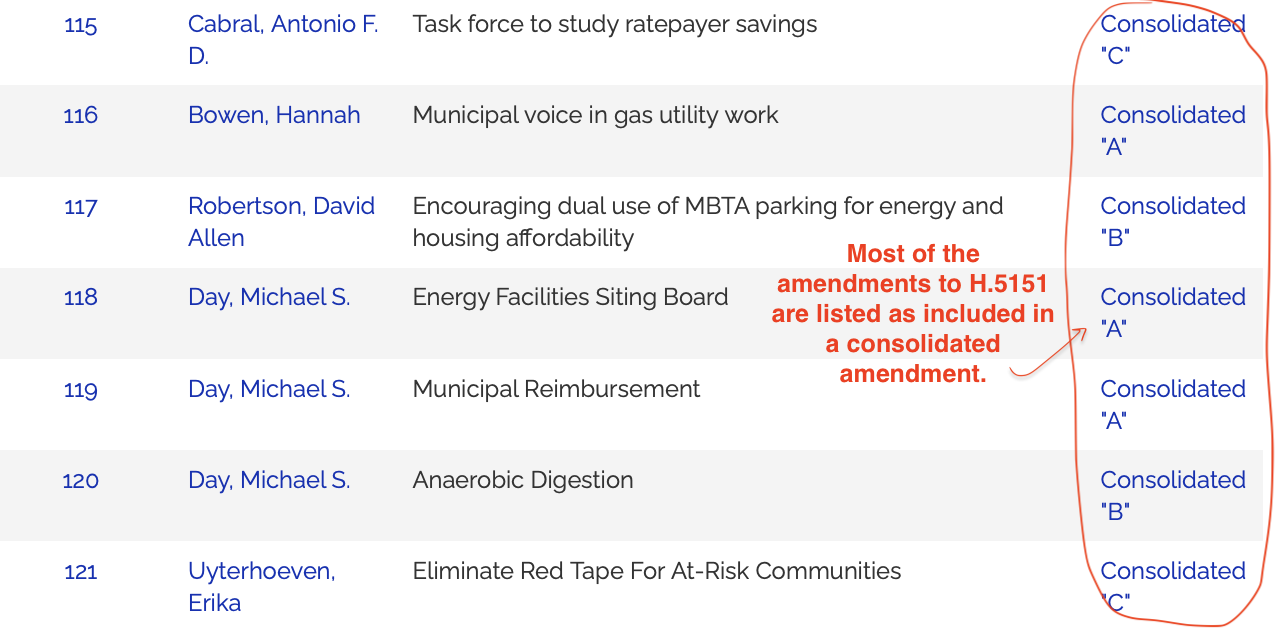
Since Consolidated A, B, and C were approved, you might reasonably think that all 108 amendments were included in the final version of the bill.
Not so fast. Alas, an examination of the actual language of the consolidated amendments reveals that the language of the “included” amendments is missing. For example, Consolidated Amendment A supposedly includes 34 amendments, but the actual language makes only three changes to the bill. In actuality, voting “for” the consolidated amendment was a vote to kill most of the amendments included. Instead of being added to the bill, they were “consolidated away.”
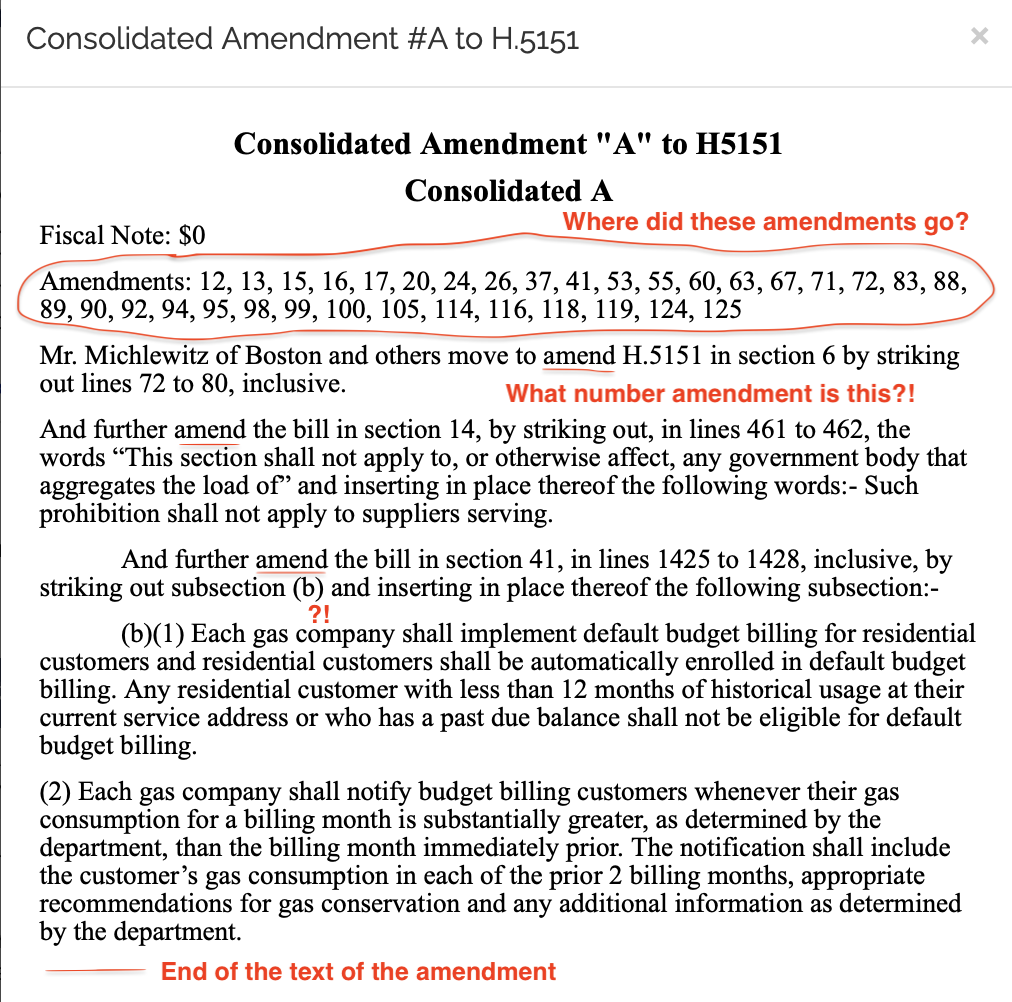
Look: I do this watchdog work full-time, and I still haven’t figured out which of the 34 amendments were passed and which ones were killed in the text of this consolidated amendment. You can bet that your representative didn’t know either when they followed leadership’s lead to pass Consolidated Amendment A.
The amendment process exists for a reason: giving rank-and-file representatives the chance to make their mark on a bill, while allowing the public to see very clearly which changes to a bill are being made and who supported them. When amendments are consolidated instead, rank-and-file representatives are disempowered, policy positions are kept behind closed doors, and the public is left guessing which changes were approved.
It also results in a public “debate” that more closely resembles a theater production than a democratic debate.
Public "debate" choreographed by leadership and dominated by the MA House's "old boys club"
This energy "debate" resembled the structure of most "debates" in the House. Certain members are pre-designated to give public speeches in support of the bill and the consolidated amendments, which are destined to pass. Certain members are pre-designated to give public speeches opposing Republican amendments, which are destined to fail. The outcomes are known; any meaningful debate has already happened behind closed doors.
With the "old boys club" of House leadership casting the roles in this drama, here's how the "debate" broke down last week:
- 4 minutes of speeches from members of the Black & Latino Caucus
- 18 minutes of speeches from women legislators
- 29 minutes of speeches from white male legislators named Mark (!)
- 51 minutes of speeches from white male legislators not named Mark
The Black & Latino Caucus makes up 13% of the legislature, yet got only 4% of speaking time last week. Men outnumber women 2:1 in the MA legislature, yet male members spoke 4x more than female members in this public debate. When legislators’ voices are sidelined, so are their constituents. Our takeaway: for representation that matters, we need free and open debate on amendments.
Still, the debate on this energy bill (H.5151) had something exciting that we don’t see often: Democrats publicly disagreeing with each other. Breaking from custom, progressive Rep. Erika Uyterhoeven made two public speeches in favor of amendments she had filed. The second, Amendment #113 to Save Mass Save, prompted a pre-assigned speech by leadership, with Rep. Tommy Vitolo as the designated opponent. Although it was ultimately voted down, 16 Democrats voted for the amendment against the will of the Speaker. By our count, this was the most Democrats to break from the Speaker on a roll call since January 2022!
At Act on Mass, we support reforms like stipend reform because we think if our rank-and-file reps should be empowered to argue (and vote!) for their amendments publicly—even if they're not named Mark. In a Democratic supermajority, we can’t leave dissent to the Republicans. If our reps disagree, we should see it in public debate.
Your rep is your voice in the state house. Did they speak last week? You can watch the debate yourself or peruse our breakdown. If not, why not? Send them an email!
ASK YOUR REP: WAS YOUR VOICE HEARD IN DEBATE?
---
Lily's Lowdown
What's up with public records law in Massachusetts?
Auditor Diana DiZoglio is pushing for a new ballot question that would subject the legislature, the governor’s office, and the judiciary to public records law. Massachusetts is the only state where all three branches of government are exempt from public records law.
What are we talking about when we say public records? The Secretary of State’s office broadly defines public records as:
The Massachusetts Public Records Law (Public Records Law) and its Regulations provide that each person has a right of access to public information. This right of access includes the right to inspect, copy or have a copy of records provided upon the payment of a reasonable fee, if any. The Public Records Law broadly defines “public records” to include “all books, papers, maps, photographs, recorded tapes, financial statements, statistical tabulations, or other documentary materials or data, regardless of physical form or characteristics, made or received by any officer or employee” of any Massachusetts governmental entity.
Unfortunately, Massachusetts does not just distinguish ourselves by exemptions from public records law. Municipalities in our state, which are subject to the law, also routinely fail to fulfill public records requests. Sometimes public employees conspire to overestimate costs, as in the case of this Lexington man. In one particularly egregious case, the ACLU requested information from municipalities across Massachusetts regarding a license plate reader program we talked about last week. Though many municipalities complied without issue, the city of Taunton initially wanted to charge $1.8 million for the request. Eventually, the Massachusetts supervisor of records allowed for the city to charge $560,000, what they claimed was the cost of the city to provide the records. While this is one egregious example of the inaccessibility of public records across the state, it’s a testament to the municipal dimension of non-transparency that infects seemingly every facet of the Commonwealth, all the way up to the most powerful state lawmakers.
This is a process with unfortunately little oversight. Noncompliance with public records law can be reported to the supervisor of records, but this process is also afflicted with inertia. If a report to the supervisor of records hits a dead end, lawsuits brought about by individual plaintiffs are the only other avenue for accountability, although these can take years and substantial resources.
Although Massachusetts is relatively extreme in its opacity, other states are also experiencing diminishing access to public records in a troubling nationwide trend toward withholding valuable information from the public. Indeed, Massachusetts numbers seem to reflect this trend; while public records requests from 2017 to 2024 almost doubled from years prior, only about half of these were fulfilled by state agencies. In 2017, by contrast, about 9 in 10 requests were fulfilled.
During a hearing this week on the potential public records law ballot question, Senator Cindy Friedman, co-chair of the committee on the upcoming ballot questions, refused the idea that the legislature should be held accountable via public records, saying, “The Legislature is a deliberative body. It is our job to think of things, to have many discussions, to talk over what our differences are. If every one of those is public…we will not be able to do our work because someone will take something out of that and turn it into a completely different message, and that’s what we will end up responding to.” Her fellow lawmakers have also expressed reluctance to open up the legislature to public records law.
Senator Friedman’s meandering response tells us that the legislature believes their work as an elected body should be closed off from the eyes and ears of the people who put them in office. She continues, saying, “We are not trying to go and do nefarious, nasty, bad things.” (The misconduct of two recent House Speakers begs to differ). Still, Senator Friedman’s response skirts around that inaccessibility of public records in Massachusetts is a disservice to high-quality journalism, government watchdogs, and members of the public looking for information they have every right to access.
Of course, even if DiZoglio’s important ballot measure passes this fall, it will not be a cure-all. The measure does not increase enforcement of public records law, leaving open a major gap. Our inability to independently verify so much of what the state government does is bad for democracy. As much as high-powered Democrats in the state want to (rightfully) point fingers at the Trump Administration for being antidemocratic, they are conveniently ignoring the secretive and unaccountable nature of their own leadership.
---
Missed a Scoop or two? You can find a full archive of all past Saturday Scoops on our blog.
---
Immigration Spotlight
As the toll of the Trump administrations' violent immigration enforcement actions continue to be felt in Massachusetts and nationwide, we wanted to continue highlighting local stories of how this is impacting Bay Staters and share calls to action.
- **How immigration enforcement is affecting a Framingham kindergarten classroom**by Suevon Lee for WBUR
- **Reformers flag immigration arrests at courthouses as Mass. lawmakers press for fixes **By Ella Adams for State House News Service (in MassLive)
- Mass. schools face millions in potential funding cuts as ICE enforcement drains enrollment by Juliet Schulman-Hall for MassLive
The legislature has still not acted to enact immigration reform.
---
What else we're reading this week
Good reporting from this week in MA politics!
- ‘You want to put me back on the street?’: Advocates brace for deep cuts to ‘Housing First’ programs Felice J Freyer, Commonwealth Beacon
- Mass. inspector general calls sheriffs’ budget process ‘opaque, chaotic and deeply flawed' by Chris van Buskirk for WBUR
- More on the sheriff issue: **This is the year to rein in free-spending sheriffs (Opinion)**by Globe Editorial Board (paywalled)
 For fun: RFK Jr. puts Dunkin’ on notice; Massachusetts governor says ‘come and take it’ by Ryan Mancini for The Hill
---
Take Action

Our legislators need to stop stalling and take action to protect us from ICE. Please use our email form to contact your representative today.
TELL YOUR REP: CO-SPONSOR PROTECT ACT>>
Act on Mass is hiring!

With elections on the horizon and a bunch more farmers markets to hit this summer, Act on Mass is hiring an organizing director! If you've got someone in mind for the role, send them our job description. :)
LEARN MORE ABOUT AOM'S ORGANIZER ROLE>>
---
Thanks for reading! Enjoy your weekend.
In solidarity,
Scotia
Scotia Hille (she/her)
Executive Director, Act on Mass