What a week!
In the days since our last Scoop: the Massachusetts House released, debated, and passed a sweeping “energy affordability” bill—all in less than 72 hours. Trump name-dropped Massachusetts in his State of the Union address, accusing us of fraud “even worse” than Minnesota. The Speaker and Senate President appeared for a joint speaking event in which they (surprisingly in agreement for once!) traded insults against the state auditor, Trump, and the concept of ballot questions. All that to say: when it comes to politics, times are weird!
Speaking of politics, there’s one question we’ve heard many times in the last year, from farmers markets to Zoom chat rooms: what happened with the audit? Since the question won with 72% of the vote, it has been mired in a back-and-forth between the auditor, legislative leaders, and the state’s attorney general. Although the ballot initiative was intended to bring transparency to our opaque legislature, its own fate has been the opposite of clear.
In honor of Sunshine Week next month, join us March 19th at 6:30 p.m. for a webinar:** “MA voters approved a legislative audit. What's holding it up?”** We will be joined by former appellate lawyer and good government advocate Jeanne Kempthorne, who will walk us through some of the murky legal concepts involved, including the question of constitutionality, the “special powers” of both legislature and auditor’s office, and the role of the attorney general.
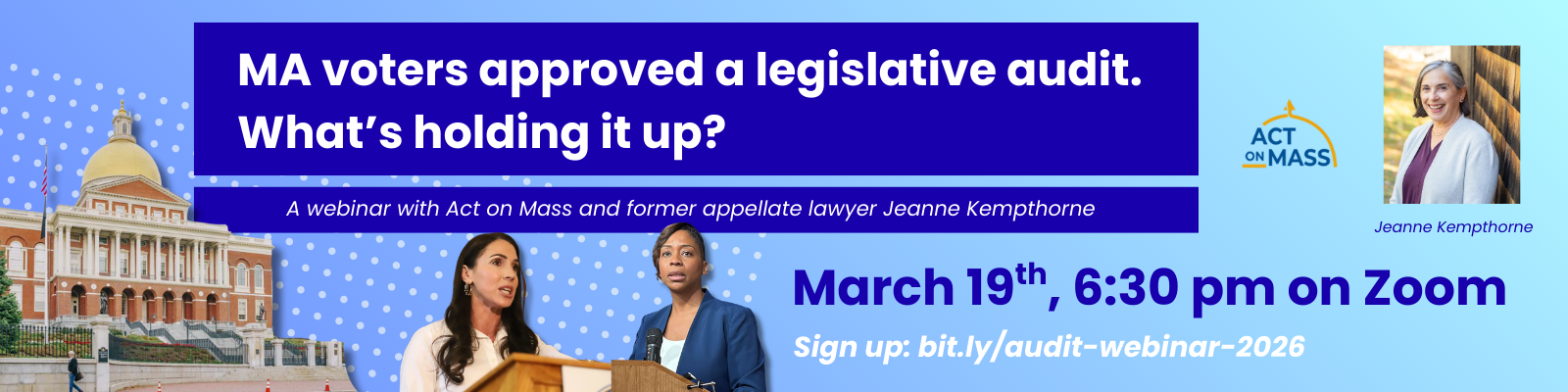
If you’ve ever wondered “what happened with the audit?,” sign up to join us on March 19th!
---
State House Scoop
In slashing MassSave, House reps concede to MAGA narrative on energy affordability
Harken back to last year, when legislators spent all of 2025 stalling on providing energy cost relief, finally releasing an omnibus bill in November that appeared to have been written by the fossil fuel industry. It would have gutted our state’s 2030 climate goals. Thanks to a public committee vote, we were aware when the bill emerged from committee, and the resulting public backlash was enough to stop it in its tracks. The effort had been stalled in House Ways & Means since then, heading us into winter with no relief on costs.
On Tuesday, a new version of the bill (H.5151) was suddenly released by the leadership of House Ways & Means. Rank-and-file Ways & Means members only had 45 minutes to read the 107-page omnibus bill and determine their vote on it. In reflection of the snap vote, 7 members were marked as “no action” on the public committee vote, meaning they missed the window to vote (intentionally or not). 10 members elected to “reserve their rights,” refusing to vote with the Chair. The bill passed Ways & Means with just over half of members (18/35) voting in favor. It immediately moved to the floor of the House to be voted on Thursday.
Here’s why the bill was controversial. Although it contained serious improvements over the November “climate rollback” bill, it relied on a “poison pill” to generate cost savings: a $1 billion cut to MassSave, our state’s landmark energy efficiency program. This potential cut was not made public before Tuesday and never received a public hearing.
MassSave is a broadly popular program that has allowed hundreds of thousands of Mass residents to weatherize their homes, reduce energy waste, and transition to higher-efficiency sources like heat pumps. Thanks to cost savings on gas, electricity, and infrastructure, residents receive back roughly $2.91 for every $1 put into Mass Save. This is not even mentioning the climate benefits of carbon emissions reductions generated by the program!
Republicans and utility lobbyists like to use MassSave as a scapegoat for rising energy costs because it is funded by ratepayers and, in our Trump-dominated national climate, clean energy is out of fashion. Yet, “MassSave makes up a relatively small part of a utility bill compared with supply and distribution costs.” The real driver of surging utility costs are high gas prices and hikes in the “delivery charges” section of your gas and electricity bills, where utilities companies charge ratepayers directly for record spending on new infrastructure, relocating their corporate headquarters, lobbying salaries, etc.
The MassSave program has received some (warranted) criticism for failing to deliver equal benefits to low-income communities. Incentives for efficiency updates have seen a higher uptake by homeowners, leaving lower-income communities and renters paying without reaping the same benefits. Last year, MassSave was redesigned to better reach income-burdened communities and renters. Far from a solution, massively cutting the program’s budget now would disrupt the work of correcting these inequities.
Indeed, though H.5151 contains no new provisions to rein in utility spending, the $1 billion cut would decimate MassSave. The program is currently halfway through its three-year $4.5 billion budget cycle, which stretches from 2025-2027. The Boston Globe estimates that the $1 billion cut would "effectively translate into a halving of [MassSave's] budget for the remaining 18 months of the cycle."
Further, though H.5151 directs cuts to be prioritized in the marketing and administrative sectors of MassSave, those sectors are only budgeted roughly $148 million for 2027. To make the $1 billion cut next year, MassSave would have to eliminate essential programs, shuttering thousands of green jobs, reducing benefits for customers, and slowing our progress towards clean energy.
You would think that this sort of legislation would be dead-on-arrival in a Democratic supermajority legislature. Legislators have criticized Trump’s anti-clean energy ideology for getting in the way of Massachusetts’ climate and energy goals. They expressed outrage at Elon Musk’s DOGE “cut first and ask questions later” approach to federal bureaucracy.
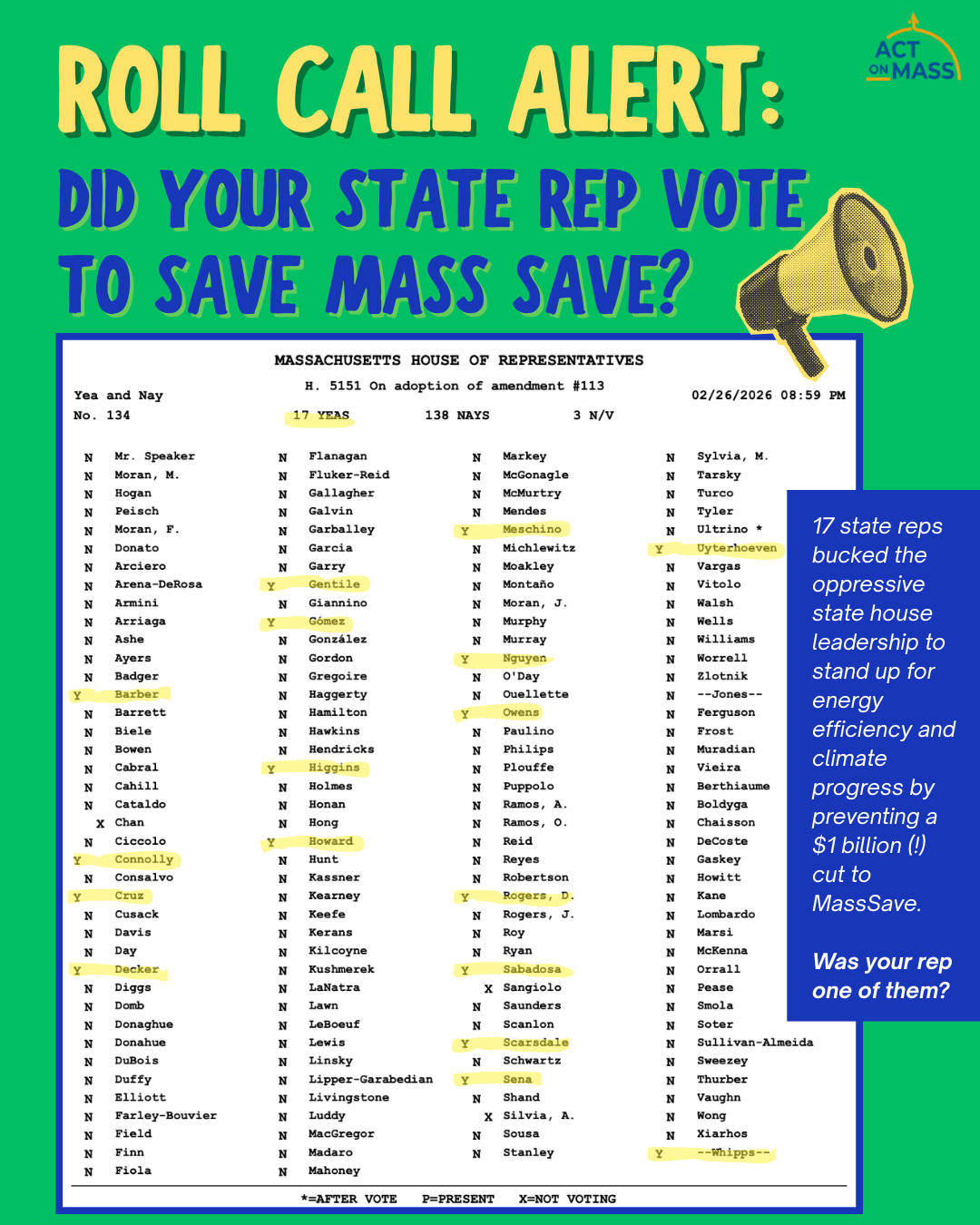
Yet, in a formal session that ran past 10 p.m. on Thursday night, the MA House passed H.5151with only 2 Democrats voting against. A “Save Mass Save” amendment (#113) which would have removed the cut garnered support from only 16 Democrats and failed. 116 House Dems instead chose to accept a MAGA framework that we need to sacrifice climate progress for relief on energy costs—protecting utilities instead of their vulnerable constituents.
See if your rep voted to save Mass Save here:
While that is a depressing outcome, it’s not all bad. For one, the measure has passed the House, but it still needs to be passed by the Senate to become Massachusetts law. We have the chance to fight these cuts through the Senate. Senators are less likely to approve such steep cuts, especially if public backlash grows, but this bill does start the negotiation between the two branches in an extreme spot.
Furthermore, as a transparency advocate who spends a lot of time thinking, writing, and speaking about the concentration of power in the state legislature, I was excited to see so many House Democrats break from leadership on an amendment—even if it was only 16.
Breaking from the Speaker and the Trickle-Down Effects of Committee Transparency
Through a combination of “loyalty pay” and an oppressive collegial culture, leadership’s control over the outcome of votes in the House is near-absolute. The Speaker’s vote sets the outcome, and that’s that.
For example, in the previous two-year legislative session, 2023-2024, only 20 Democratic members out of 132 voted differently than the Speaker even once. 111 members followed the Speaker on every single vote in the two year session. Many of the members who broke are conservative Democrats who vote occasionally with the Republicans. Still, most often, the Democratic caucus votes unanimously.
During all of the roll call votes taken last year (2025), only 10 out of 132 Democrats voted differently than the Speaker at least once. With that context, the disputed vote on Amendment #113 nearly doubled the number of members who have broken with the Speaker this session, in a single vote. It has been genuinely years since we have seen progressive members of the Democratic caucus voting together against leadership.
There are a lot of things that could explain this, including the extreme pressure of our political moment as we face down Trump, or the contested elections some of the 16 off-voters are facing. However, as a longtime advocate of transparency changes in our legislature, I have to zero in on how increased committee transparency has led to this moment.
After years of fighting for the simple right to see how our representatives vote, we notched a major victory last year when the House and Senate finally agreed to publicize their committee votes. In November, this meant that constituents were made aware when the first energy bill moved through its committee—the climate rollback bill. We were able to apply pressure: representatives knew constituents would see their vote and that they could face backlash for voting with leadership. This convinced multiple members to vote against the will of the chair.
Although the original “climate rollback” bill passed its committee, the precedent was set that the public was watching. This put leadership on the defensive, resulting in the removal of the “climate rollback” provisions and several months of additional discussion behind closed doors. Plus, the two progressive members of the committee who publicly “reserved their rights” rather than voting with the Energy Chair also set a precedent: progressive members could buck leadership on this issue. On the Ways & Means vote this week, that number became 10. And on the House floor, it became 16.
Before public committee votes, none of this build-up would have happened. The bill would have moved through committee with no warning and no opportunity for constituents to make their voice heard to representatives. Environmental groups would have done great work to raise alarm, but with no way to see if our representatives followed through, the accountability mechanism was broken.
Public committee votes are a huge tool in our toolbox to resist the corporate-backed control of House leadership, and the effects trickle down even to the House floor. When constituents have more chances to be involved in the process, more rank-and-file representatives feel empowered to resist leadership. Although it wasn’t enough to stop the House from approving the MassSave cut this time, we will continue to see the cumulative impacts of these transparency changes.
If your state rep was one of the 17 House members that voted to save Mass Save, make sure to thank them! If voted to cut MassSave, feel free to express your disappointment. What matters is that they hear from you and know that you will keep checking up. (Email forms courtesy of ProgressiveMass!)
TELL YOUR REP: THANKS FOR VOTING FOR MASSSAVE>>
TELL YOUR REP: DISAPPOINTED IN YOUR VOTE>>
---
Immigration Spotlight
As the toll of the Trump administrations' violent immigration enforcement actions continue to be felt in Massachusetts and nationwide, we wanted to continue highlighting local stories of how this is impacting Bay Staters and share calls to action.
- An American mother forced to choose between country and family (paywall) By Giulia McDonnell Nieto del Rio for the Boston Globe
- Plans for proposed ICE facility in Merrimack, N.H., won’t move forward, governor says By Amanda Kaufman and Amanda Gokee for Boston Globe
The legislature has still not acted to enact immigration reform. See the "Take Action" section for more details!
---
Lily's Lowdown
Legislative inaction maintains inequities in school building repairs
Massachusetts proudly touts having one of the highest-ranked public school systems in the country, but that obscures a much deeper problem.
Across the Commonwealth, major disparities are pervasive. In lower-income and minority communities, school facilities are significantly lacking behind their suburban counterparts. A report by MassINC Policy Center in 2025 found that the Massachusetts School Building Authority(MSBA), a quasi-independent state program that was created by the Legislature in 2004. It partners with municipalitiescommunities to update education facilities, reimbursing. The program reimburses communities with 1% of the 6.25% sales tax collected by the state.
The main issue with the program, according to MassINC, is that the combination of “...state funding tied to sales tax revenue growth rather than an objective regular assessment of financial needs” plus “a competitive process that requires local school districts to opt in” means that poorer urban districts receive significantly less than wealthier ones. This results in significant underrepresentation of Boston and the Gateway Cities in MSBA grant-receiving schools. Boston Globe findings in 2023 originally uncovered that for every $10,000 spent per student in majority white districts, just $6,400 were spent per pupil on students in majority nonwhite districts. MassINC findings in 2025 noted the same discrepancy two years later.
Two years ago, the Boston Globe published an investigation into Massachusetts education spending, which found that the structure of MSBA’s grant program skews funding in favor of wealthier, whiter districts. As a result, schools in cities like Lynn, Lowell, and Holyoke are stuck with dilapidated buildings, overcrowding, and lack basic needs like auditoriums, cafeterias, and and gymnasiums.
Although former director Jack McCarthy described the racial disparities as part of “an economic reality I can’t fix,” it’s clear that the MSBA’s structure needs upheaval, which necessitates action by the Legislature. Legislation to update the MSBA, including H.512, An Act to expand the Massachusetts School Building Authority and create a new program to assist public school districts with 21st century technology upgrades, have stalled out in the Committee on Education.
Meanwhile, as the legislature stalls, students in lower-income districts are stuck in aging buildings.
---
Missed a Scoop or two? You can find a full archive of all past Saturday Scoops on our blog.
---
Take Action

Our legislators need to stop stalling and take action to protect us from ICE. Please use our email form to contact your representative today.
TELL YOUR REP: CO-SPONSOR PROTECT ACT>>
---
Thanks for reading! Check back next week for part 2. :)
In solidarity,
Scotia
Scotia Hille (she/her)
Executive Director, Act on Mass