Happy Saturday,
Exciting news to share!
As the leading organization focused on transparency and accountability at the state level, Act on Mass uses our voice during election years like this one to endorse candidates that are expected to embody our mission in the state house.
Since we were founded in 2018, we have seen an incredible phenomenon: more and more candidates challenging incumbents and running on the message of transparency in the state house.
Faced with a broader array of choices, we want to get our community involved. Therefore, we are seeking volunteers for an Act on Mass Endorsement Committee to solicit, discuss, and vote on endorsements**.**
Want to get involved in this year’s election cycle but not sure where to start? Want to learn about and advocate for movement candidates in your area? Apply for Act on Mass’ Endorsement Committee!
Potential committee members commit to attending two deliberative Zoom meetings, participating in at least one candidate interview, and upholding the Act on Mass mission of shifting political power in Massachusetts from the top to the grassroots.
If you think this sounds like a good fit for you, please fill out our interest form! You will hear from a member of our team in the next few weeks.
JOIN ACT ON MASS’ ENDORSEMENT COMMITTEE>>
---
State House Scoop
After years of organizing, will we see state action on immigration?
The past few weeks have seen an outpouring of action and public pressure around immigration. Bay Staters watched with apprehension as federal agents continued to bring violence to Minnesota and our New England neighbor, Maine, and jumped to action. Neighbors in my area organized to 3D-print whistles and plan to protect each other if ICE comes here next. 200 people packed the State House (paywall) to protest ICE and demand action from state leaders. In anticipation of a national boycott, many local businesses released statements in solidarity. High schoolers across the state organized walkouts.
After years of organizing, the push for state immigration reform seems to finally be resonating in the halls of power. State officials are now actively discussing legislation to update our state laws with respect to immigration enforcement.
The political forces at work behind this legislation tell an interesting story about power in our state. Let’s talk about it.
Black and Latino Caucus immigration action shows importance of “horizontal” organizing
One feature of consolidated power structures, such as the Massachusetts state legislature, is that power flows vertically through hierarchical levels, rather than horizontally between colleagues. Our legislature is a textbook example, with policy-making power concentrated in very few hands and nine levels of pay (doled out by leadership!) that make each member’s position in the hierarchy very clear.
Theoretically, in a representative democracy, each member of the legislature is equally empowered to take action on behalf of their constituents. Yet, in our state house, when 92% of Democrats vote with the Speaker on every single vote in a 2-year session, there is little incentive for reps to organize their colleagues to support something the Speaker opposes. Any energy to support legislation has to be directed up, not sideways. For constituents, this means that we rarely see action on popular issues that aren’t prioritized by legislative leaders, including labor protections, legislative transparency, and (you guessed it!) immigration reform. Even if most legislators support action, they are unable to organize collectively to get it done without the support of leadership.
As power has consolidated over the last few decades, there is some indication that state house leadership intentionally sought to interrupt these “horizontal” member-to-member bonds. One former representative noticed that “camaraderie” had gone down significantly during his decades in the House, initiated by “authoritarian” Speaker Tom Finneran:
“By design, it seems as if the legislature is kept apart from having formal sessions. [When I started] there was a camaraderie, as we’d be there till 2, 3am and the Speaker would then have a dinner break and a bunch of reps would go to dinner together, and it’s the best way to get to know your fellow house member. There’s no way otherwise that a rep from the Berkshires would ever know anything about a rep from the Cape.”
“When Tom Finneran became Speaker, he eliminated dinner breaks, would order food in and made people eat in the members’ lounge. There was a lot more controlling of the agenda. There were fewer formal sessions that broke down the camaraderie.”
This lack of informal opportunities for socializing between rank-and-file members has coincided with a shrinking of caucus activity in the House and Senate. Caucuses like the Progressive Caucus and the Black and Latino Caucus have historically served as homes for member-to-member organizing in our legislature, but have been largely inactive in recent years. This left legislators with priorities that differed from leadership without a political home for organizing.
As we wrote in a Scoop last summer, the 52-year-old Black and Latino caucus was “back in action” under new leadership as of last year. The caucus now convenes 26 legislators of color to push for issues impacting Black and Latino residents across the Commonwealth.
Last Wednesday, we saw the benefit of this renewed “horizontal” organizing as the Black and Latino Caucus announced their filing of the PROTECT Act to address immigration enforcement. Beyond scoring points for creative acronym-ing (“An act Promoting Rule of law, Oversight, Trust, and Equal Constitutional Treatment”), this legislation addresses many of the key issues raised by advocates and immigrant communities. Members of this caucus represent many of the areas most impacted by ICE surges, which have targeted Black and Latino communities.
The PROTECT Act (HD.5608) builds upon previous immigration legislation, such as the Safe Communities Act, which has been stuck in “legislative limbo” since 2013 (!). It PROTECT Act would:
- Ensure that state and local law enforcement resources are not used for ICE
- Bar ICE arrests from happening in or around courthouses without a judicial warrant
- Ban future 287(g) agreements, a.k.a. contracts between state entities and ICE
- Require that detainees have access to language interpretation and legal services
- Responding to more recent developments, it would require prisons to track detainees so that family can locate them within the system
- Mandate that applicants to state and local law enforcement positions disclose any previous employment with ICE or CBP
- Additional provisions
Throughout the devastating ICE “surges” in our state’s immigrant communities since last year, legislative leadership stated openly that they did not plan state action on immigration. Now, we’re seeing an organized group of legislators use the structure of a caucus to stand together to say: actually, the state can do more.
Do you know the last time your legislator took a public stance that differed from legislative leadership? Do you know what caucuses they’re in, or which other legislators they work with most regularly? If there’s an issue that really matters to you, check in with your legislator about what kinds of “horizontal” organizing they’re doing with colleagues to get it done. “I’ve spoken with leadership” is a necessary but insufficient response from our elected leaders. Remember: they work for you!
Healey picks up the thread on immigration action
One day after the launch of the PROTECT Act, Governor Healey held a press conference of her own on the issue of immigration. Gov. Healey announced two policy vehicles: an executive order(EO), which will take effect immediately, and new legislation filed in the Legislature (H.5050).
Here’s a succinct breakdown of the key features of the two acts by the MIRA Coalition:
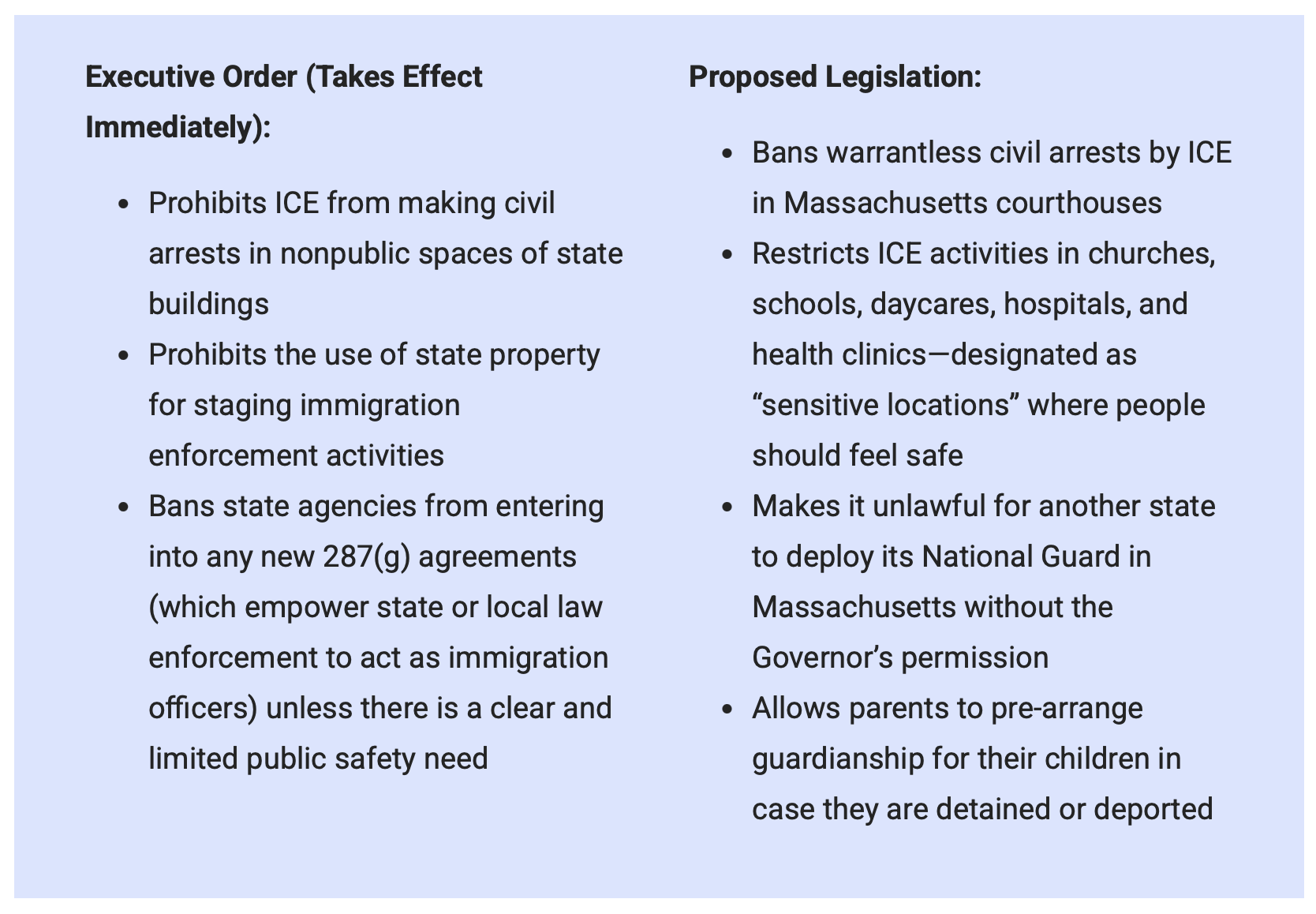
The takeaway from immigrant justice groups is mixed. Some are thrilled to see a state leader proposing action to protect our communities from ICE, after many years of inaction. Others caution that Healey’s EO and legislation do not go far enough and do not address the additional needs raised by immigrant communities. Crucially, unlike the PROTECT Act and the Safe Communities Act, Healey’s legislation would not ban the use of state and local law enforcement resources for ICE.
Some have also raised doubts about Healey’s willingness to enforce these new measures. When asked by reporters about how her administration would enforce the ban on warrantless ICE arrests in nonpublic areas of state property, she emphasized her “hope” that the laws would serve as a deterrent for ICE. With the federal government trampling over state jurisdiction from Minnesota to California, we need stronger assurances from our governor.
Healey's proposed legislation was filed as a policy rider on a $411 million supplemental spending request, for which she requested a vote by April 30th. Though it’s become increasingly common for our legislature to pass policy changes through big spending bills (because they have stricter deadlines), this is a revealing move. It is an indictment of our legislature that even the state’s governor did not want to risk filing immigration action legislation as an independent bill. Despite incredible public pressure and an 80% Democratic supermajority, a vote on immigration action is not guaranteed.
For me, this episode highlights a lesson we have also learned from our national Congress: executive action is not a replacement for an effective and responsive legislative branch. By design, the legislative branch of our government is most accountable to the people. The actions of the Black and Latino caucus in our legislature are a good example, introducing legislation that was informed by organizing in their communities.
When gridlock in the legislative branch stalls relief for constituents, executives from President Biden to Governor Healey have responded with executive action. At worst, this ceding of policymaking ability has led to the complete abuse of executive power seen under President Trump. At best, it results in policy that is less informed by the communities it impacts.
We have a legislative branch for a reason. The level of inaction and delay in our state legislature is indefensible; still, the solution lies in the legislature itself. We need our own representatives empowered to organize amongst themselves, to deliberate, and to move legislation that is desperately needed—even without the Speaker’s approval. For that, we need open debate, accountability, more organizing in caucuses, and an end to tools of power like "loyalty pay."
With that said, the executive does have a “bully pulpit” to apply pressure for action from the legislative branch, and I’m glad Governor Healey is finally using it. For example, Senate President Spilka had previously dismissed state immigration action, but she showed up to Healey’s press conference and vowed action. This week, the House hosted closed-door listening sessions with members to discuss the various immigration bills. It appears that legislative leaders—even Republicans—are open to some of the measures in the PROTECT Act.
Did your legislator participate in these listening sessions? Are they advocating for immediate action to protect our communities? Are they standing with their colleagues in the Black and Latino caucus? Our friends at Progressive Mass set up a handy script for you to check.
Click here for your legislator's phone number to call their office: "I was glad to hear that the MA House held listening sessions this week about action to take to rein in ICE and protect our communities. It is important in Massachusetts that we prevent state and local law enforcement from collaborating with ICE or being deputized as ICE agents. What priorities did you bring up in the listening sessions this week, and how are you working with colleagues to turn them into law?"
Click here to write an email to them.
TELL YOUR REP: PROTECT OUR DATA TODAY>>
---
Introducing: Lily's Lowdown
Where would we be without a regular intern column? I'm happy to report that Act on Mass' Lily Power has graciously agreed to become a regular Scoop contributor with a new column. Here is this week's "Lily's Lowdown"!
--
AI bubble inflates in the Commonwealth
With artificial intelligence cropping up in just about every facet of our lives, for better or worse, the industry is seemingly wedging its way into the Boston workforce. Elon Musk’s xAI recently held an invite-only recruitment event in Boston last week with the Massachusetts AI Coalition. Although there is no confirmation that the company is planning to set up shop in Massachusetts, the event promised a glimpse into xAI’s “2026 roadmap.”
The star of xAI, of course, is Musk’s brainchild, “Grok,” the chatbot that has come under fire in recent months for generating nonconsensual sexual images of women and calling itself "MechaHitler.” To support Grok’s massive data needs, Musk’s company is currently expanding a massive data center in Memphis, Tennessee, where residents say the center is only worsening the city's pollution problem.
The proliferation of AI has meant so-called “hyperscale” data centers are increasingly cropping up across the country, to support the high energy usage of AI tools. The increased capacity of these data centers means they require more electricity, as well as more water for cooling—up hundreds of thousands of gallons per day. In addition to driving up energy costs for residents, these centers’ water consumption can impact residential drinking water. Just ask this Georgia woman whose faucet water has become undrinkable.
Data centers are rocking local communities, too. In Lowell, residents say the Markley Group’s data center, located in the center of a residential neighborhood, contributes to noise and air pollution. This all comes in tandem with yearslong speculation of a hyperscale data center coming to Westfield, MA. Representative Mike Finn, who helped maneuver tax cuts to incentivize tech companies to come to Massachusetts, promised that the construction of one of these data centers in his district would bring “high tech jobs, they’re very good paying well-paying jobs.” We should note, however, that recent reporting by the Shoestring suggests that plans for a Westfield data center may have been abandoned altogether.
Yet even as environmental and energy cost concerns across Massachusetts communities mount, AI has so far been met with a warm embrace by state leadership. In 2024, the Legislature passed the FutureTech Act, which authorized more than $1.2 billion in bonds for AI technology to improve the state’s digital infrastructure. In June 2025, the Healey Administration launched ‘Future Ready: AI in the Classroom,’ a professional development program for teachers aimed at integrating AI into education. It’s currently being piloted in schools across the state. At a BU event in December, the Healey administration praised the state’s investment in AI infrastructure and touted plans for more in the near future.
Already, Healey’s cozying up to AI just might be coming back to haunt Governor Healey in the form of attack ads from a Republican candidate, Brian Shortsleeve, who is running to unseat her this November. Earlier this week, the Shortsleeve campaign openly admitted they used generative AI to create a fake radio ad posted to the campaign's Instagram. Healey’s voice is mimicked to proudly say things like, “We have one of the highest electricity rates in the nation thanks to me for slapping on excessive fees to fund my climate agenda,” and that Massachusetts is “ the second most costly state to retire in; more than 5,000 employers have closed their doors, and we have sent more than 12,000 private sector jobs to Republican states.”
The Healey campaign and the Massachusetts Democratic Party seem to have brushed this off, but implications are real; deepfakes and other generative AI is not regulated by the state's election laws. In other states, regulations have been passed to require disclosures for or eliminate the use of AI in campaign messaging leading up to an election.
AI Governor Healey aside, the primary issue is that constituents’ concerns about data centers are glaringly absent from their dialogue about AI. Despite her administration’s promises to reduce energy costs and promote clean energy, Governor Healey’s AI approach seems more attuned to the monied interests of Elon Musk and other unaccountable elites. Instead of letting big tech bulldoze into Massachusetts communities, the commonwealth needs comprehensive state regulation to ensure that constituents' voices are heard as we continue to navigate the landscape of AI.
TELL YOUR LEGISLATOR: WE NEED AI REGULATION>>
---
Also happening in the Commonwealth
Some other stories from local and regional news:
- Governor Healey released her proposed state budget last week. Here's Commonwealth Beacon on a major area driving budget spending—rising health care costs.
- In response to November's climate rollback bill, our allies at the Sierra Club are taking the bold step of calling for House Energy Chair Mark Cusack's removal. Leadership's least favorite thing: accountability.
- Act on Mass ally and documentarian Aaron Singer has a new blog post exploring the success and failures of local news coverage of legislative dysfunction: "No Door, No Representation"
---
Missed a Scoop or two? You can find a full archive of all past Saturday Scoops on our blog.
---
Take Action
Act on Mass is hiring! - Online Media and Digital Organizing Internship
The time has come to bring new friends aboard the Act on Mass team — we’re hiring an intern to help with our website, social media, and digital communications this semester! The internship is fully virtual and comes with a small stipend.
If you know any savvy folks that might be interested, please send them our way. You can access the job posting here.
Applicants should send a resume to the Executive Director, Scotia Hille: scotia@actonmass.org. No cover letters.

Want to get involved in this year’s election cycle but not sure where to start? Want to learn about and advocate for movement candidates in your area? Apply for Act on Mass’ Endorsement Committee!
CHECK OUT AOM'S ENDORSEMENT COMMITTEE>>
---
Thanks for reading! Hope you are enjoying today's snow flurries. Thank you for taking action.
In solidarity,
Scotia
Scotia Hille (she/her)
Executive Director, Act on Mass