Good evening,
It was a big week for Governor Healey!
Gov. Healey launched her re-election campaign on Tuesday, one year to the day since Trump’s first inauguration. Although there’s a crowded field of Republicans angling to challenge her, her choice of date and initial rhetoric made it clear who she’s running against: President Trump. She criticized Trump for pushing up costs, taking away healthcare, and cruel immigration tactics—a change of tact her more conciliatory approach of a few months ago.
On Thursday, members of the Massachusetts House and Senate gathered at the State House for Governor Healey’s “State of the Commonwealth” speech. She used the speech to hammer on the message of “affordability,” touting actions taken by her administration to cut costs for Bay Staters. For a rundown, check out GBH's "5 takeaways from Gov. Maura Healey's 2026 State of the Commonwealth."
Healey also launched a new cost-cutting measure during the speech itself. As we’ve discussed over the past few weeks, the legislature’s shady tactics and eventual delay on energy legislationhas left Bay Staters with sky-high energy bills this winter. Healey announced Thursday that her administration was mobilizing $180 million in state funds to reduce electricity and gas bills by 25 and 10 percent, respectively, for February and March.
Although this is important temporary relief (and makes for a splashy headline!), don't book vacation tickets yet! Almost all of the cost-savings will be paid back by consumers through higher bills for the rest of the year, while utilities companies hold on to their profits. We can appreciate that action is taken, but this is not a replacement for longer-term reform of energy sourcing and utility profiteering.
If your head has been spinning with the news on energy legislation and the risks to our state’s climate goals in recent months, I’ve got good news for you: Act on Mass is hosting a webinar with our friends at the Sierra Club and 350 Mass to discuss the ins and outs of recent legislative shenanigans on energy!
Join us on February 5th from 5:30 - 6:30 PM for “Make Your State House Fight For You: A Climate and Transparency Webinar.” We’ll debrief the recent developments in energy legislation and outline how our fight for transparency and accountability is essential to climate progress in our state.
RSVP: MAKE YOUR STATE HOUSE FIGHT FOR YOU>>
---
State House Scoop
A trip to Texas highlights the importance of legislative action in Massachusetts
Last week, I (Scotia) took a personal trip to Austin, TX to visit a friend from college. It was supposed to be a break from my daily perseverating over the triumphs and failures of the Massachusetts state legislature. I enjoyed some sunshine, got barbecue, and talked some (later vindicated!) smack about the Patriots-Texans game.
I also picked up a local newspaper, which I try to do whenever I visit a new place. On page 2 of the Austin Chronicle, I was surprised to find an article that referenced Massachusetts’ new Reproductive Shield Law:
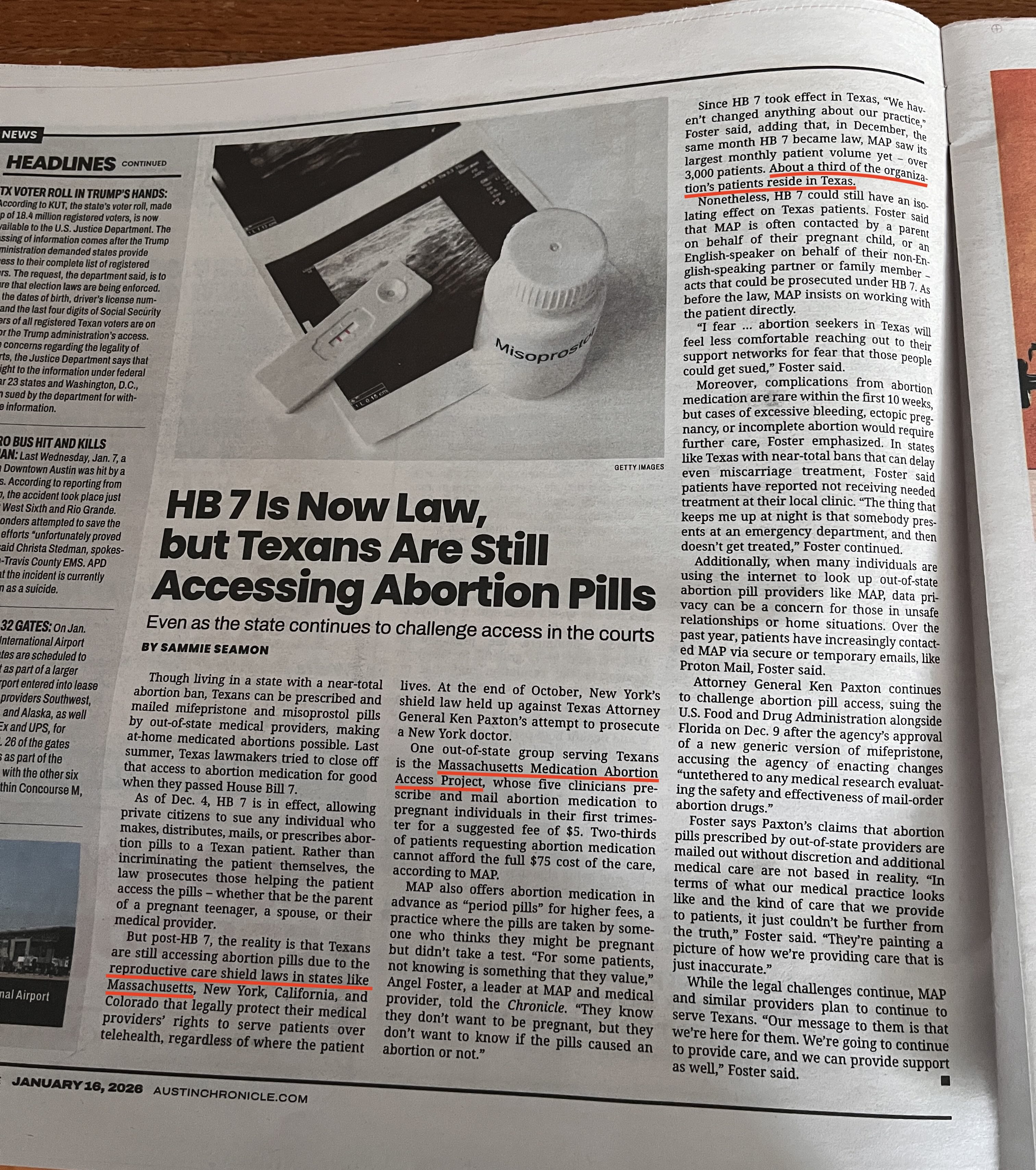
Page 2 of the January 16th Austin Chronicle. Link to the full article: HB 7 Is Now Law, but Texans Are Still Accessing Abortion Pills
Reading the article, I was reminded once again how important it is for us to be passing good state laws in Massachusetts. Because of Massachusetts’ reproductive shield law, which was first passed in 2022 and updated in 2025, 1,000 Texans per month (!) are still able to access reproductive care amid draconian laws that would criminalize their access.
Abortion has been banned in Texas since August 2022, shortly after the U.S. Supreme Court overturned Roe v. Wade. Considered to be one of the strictest bans in the country, Texas’ ban starts at 6 weeks into a pregnancy and allows no exceptions for rape or incest. Abortions are allowed for extreme medical emergencies, but this definition is unclear and penalties are steep for doctors making this judgement: if they make the wrong call, they “face a sentence of up to 99 years in prison, fines and the loss of their medical license.” The result has been a near-total shutdown of abortion care in Texas—a state of 31 million residents—putting lives at risk.
Yet, as the Austin Chronicle article highlights, clinics in states like Massachusetts have managed to connect some Texans with abortion care through telehealth. In response, Texas’ Republican-led legislature last year passed HB 7, which sets up an effective “bounty hunter system,” allowing private citizens to sue anyone who “makes, distributes, mails, or prescribes abortion pills” to a Texas resident—including out of state providers. There are particular incentives for the father, sibling, or grandparent of an impacted fetus to sue. I’ll quote the Austin Chronicle directly on the implications of this legislation in Texas:
“The bounty system incentivizes a vengeful ex-lover, a snooping neighbor, or truly anyone to turn in couples trying to obtain abortion care [or] a parent helping their minor child and… take home a significant monetary reward out of the state’s pocket and resources.”
Not only does this law endanger people in Texas, but it is clearly intended to project Texas’ abortion ban to other states. This is where the reproductive shield laws come into play.
Massachusetts is one of 8 states that protects medical providers’ right to provide reproductive healthcare regardless of where a patient is located, which includes telehealth. Last year, the Legislature updated Massachusetts’ shield law to further prevent the sharing of sensitive data, such as a physician’s name, and explicitly ban state and local authorities from cooperating with out-of-state investigations of medical care that is protected in Massachusetts. This law allows Massachusetts doctors to keep providing reproductive care to Texans without fear of HB 7.
The new shield law is also, as we’ve noted before in the Scoop, the only new law passed last year that explicitly responds to new threats under the Trump administration.
Good laws are good: let's do it more often!
When I discuss my frustrations with inaction in our legislature, I often get questions about democracy. People ask me: “isn’t inefficiency a function of democracy? Isn’t slow action preferable to quicker, authoritarian decision-making?”
My short answer: yes! Absolutely! The long answer: yes, and we could stand to set the bar a little higher than the Massachusetts’ legislature’s current pace. Somehow, despite our full-time status, the 40 states with part-time legislatures manage to get more done in a legislative session than we do.
For example, Texas has a part-time legislature. Their legislators meet in session only in odd-numbered years, for 140 days. During last year’s regular session, which wrapped in June 2025, 8719 bills were filed, of which 1213 became Texas law.
Meanwhile, in Massachusetts, our legislators filed 7854 bills last year and took the entire year to pass 101. In the previous 2-year legislative session (2023-2024), our legislature filed 8177 laws and passed 496.
Here’s my point: Massachusetts’ ability to produce good, progressive legislation has impacts far beyond the borders of our Commonwealth. If conservatives can efficiently weaponize their Republican majorities to push their agenda on other states, states like Massachusetts need to be prepared to respond, and quickly. The updated reproductive shield act passed last year is a great example of how a few tweaks of state law can protect us from overreach by authorities in places like Texas. There is more to be done to shore up our protections, on everything from abortion care, to LGBTQ protections, to immigration action.
Here’s one thing our legislators could do immediately: speed up the passage of strong data privacy protection legislation.
Last year, the State Senate passed a comprehensive data privacy bill (S.2608) that would limit the types of personal data that tech companies are allowed to collect. It would also ban outright the sale of “sensitive data,” including health care data, precise geolocation, and identity markers such as ethnicity or immigration status. The House voted a similar bill out of committee in November (H.4746), but it has sat in Ways & Means since then.
As we discussed a few weeks ago, passing this legislation is essential to protect us and our neighbors from new surveillance tools being mobilized by ICE. It also has implications for those accessing healthcare in our state and those providing it. If policies like Texas’ HB 7 can turn anyone into a vigilante, we need to make sure that our geolocation and health care data is not being sold on the web.
Tell your legislator: pass data privacy legislation today!!
TELL YOUR REP: PROTECT OUR DATA TODAY>>
---
Immigration spotlight
As the toll of the Trump administrations' violent immigration enforcement actions continue to be felt in Massachusetts and nationwide, we wanted to continue highlighting local stories of how this is impacting Bay Staters and share calls to action.
- ‘Are we eventually going to ban the entire world?’ Trump’s latest visa crackdown could hurt region’s economy, schools. (paywall) By Anjali Huynh, Omar Mohammed and Christopher Huffaker for Boston Globe
- DHS launches 'Operation Catch of the Day' enforcement action in Maine By Luke Barr and Bill Hutchinson for CBS News
- Bill filed to ban ICE operations at Massachusetts courthouses by Tim Dunn for Boston Herald
- OPINION: What ICE is doing is abhorrent. But here’s why canceling the state contract to house its detainees might not be the right thing to do. By John Grossman in Commonwealth Beacon
Tell your legislator: we need state action to protect us from ICE! For more ideas, read our recent Scoop: "ICE is a danger to our communities. What can our state leaders do about it?"
TELL YOUR LEGISLATOR: ICE OUT OF MASS>>
---
What (else) we're reading this week
Some other stories from local and regional news:
- How Mass. sheriffs add thousands of dollars to their six-figure salaries by Matt Stout for Boston Globe
- **What’s behind Massachusetts’s $250m investment in health insurance subsidies**by Jennifer Smith for Commonwealth Beacon
- National dark money anti-pot group bankrolling efforts to ban recreational marijuana in Mass., Maine by Chris Lisinski for Commonwealth Beacon
- ‘Spiral of doom’: New report sounds alarm over MBTA’s financial future by Jeremy Siegel for GBH News
---
Missed a Scoop or two? You can find a full archive of all past Saturday Scoops on our blog.
---
Take Action
Join Act on Mass and climate allies for a webinar! - February 5th, 6:30 PM

Join us February 5th on Zoom to debrief the recent developments in energy legislation and outline how our fight for transparency and accountability is essential to climate progress in our state.
RSVP: MAKE YOUR STATE HOUSE FIGHT FOR YOU>>
"We keep us safe": save LUCE hotline to report ICE sightings in your neighborhood

Help keep your own neighborhood safe by keeping an eye out for ICE vehicles and reporting sightings to the LUCE hotline. LUCE can also connect you to groups doing ICE watch in your area for training. Check out their website today!
WE PROTECT US: EXPLORE LUCE RESOURCES>>
---
That's the Scoop. Stay warm and keep each other safe.
In solidarity,
Scotia
Scotia Hille (she/her)
Executive Director, Act on Mass