As 2026 approaches, I am reflecting with much appreciation on what a year it’s been for Act on Mass.
We saw joint rules passed for the first time 6 years (!!), including our key demand of public committee votes. Our “Transparency on Tour” allowed us to meet so many of you in person, on town greens and in parking lots from the Cape to the Berkshires. We hosted workshops, forums, and presentations around the state. We connected with ally organizations to push for a better legislature together.
Although our legislators may not be big fans of accountability, Act on Mass is. As we make our plans for next year, we wanted to get some feedback from our community on how our year at Act on Mass was for you. Whether you joined us at an event, volunteered with us in person, read the Saturday Scoop, or any other ways of engaging our work, we want to hear from you! Please fill out our short feedback form here:
And speaking of engaging with Act on Mass, I’ll remind you that we have another State House 201 workshop coming up this Tuesday December 16th, at 6:30 pm on Zoom. Join us to build your watchdog skills and to learn more about new tools like the Beacon Hill Tracker!
---
State House Scoop
As temperatures drop, high energy costs are the price of Beacon Hill inaction
You might remember a few weeks ago, when a bill that would have rolled back our state’s 2030 climate laws was stopped in its tracks by the power of a public committee vote. Despite a bevy of well-timed donations from fossil fuel lobbyists, Beacon Hill leadership responded to the public backlash and declined to act on the bill before the legislature’s winter recess.
Even at the time, the win was bittersweet: the wishlist of fossil fuel industry priorities had been tacked onto an energy affordability bill aimed at lowering costs for ratepayers. In October, we had covered the legislature’s slow response to spiking energy costs as winter approached. If the Energy committee had released their ill-fated bill any time earlier in the year (reminder: the legislative session started in January!), we might have had time for a revised version before winter. As ratepayers, we will pay the price.
And what a price! News broke this week that Liberty Utilities, which services the area around Fall River, has asked the Department of Public Utilities (DPU) to approve a 55% hike in gas rates. This could raise customer’s gas bills as much as $80/month on average.
According to reporting, the main driver of the price increase is Liberty’s massive pipe replacements. The company is also recovering costs for changes to its online portal and relocating its headquarters within Fall River. Meanwhile, they’re also asking for approval for a 9.9% rate of profit going to shareholders: the highest allowed. Passing record costs to beleaguered consumers while maximizing profits for your rich shareholders– sound familiar?
Indeed, the Liberty Utilities situation is but an extreme example of an all-too-common story these days. Here’s how Channel 5 put it: “Take a look at any gas bill this winter, and it's clear that spending on gas pipes is a large reason bills keep climbing in Massachusetts.”
This crisis has been building for years. Under current regulations, infrastructure and operational spending is the only aspect of their work utilities can take profits on. Gas has to be delivered at-price. Therefore, utilities have an incentive to over-spend on infrastructure. In short, “the more money they spend on pipelines, the more money they make.” In Massachusetts, spending on gas pipes has grown significantly in the last decade, peaking at $901 million this year– a 300% increase since 2015.
Meanwhile, Massachusetts law calls for phasing out natural gas for heating by 2050. And, to quote Senate Energy Chair Michael Barrett, "every time you put in a new gas pipe, it's 40 years addition to your monthly gas bill.” This means that utilities are undertaking massive spending projects to boost profits, incurring costs they can pass on for decades, all to build gas infrastructure that will be phased out before its lifecycle. And as energy efficiency programs like MassSave transition more homes to non-gas heating sources, a pool of fewer and fewer gas customers will be left to split the costs for this infrastructure.
Last year, in response to ballooning energy costs, the legislature did instruct DPU to force gas companies to reign in spending. DPU lowered the cap on spending and encouraged companies to prioritize small leak repairs rather than wholesale pipe replacement. Nevertheless, state gas companies have already announced plans to spend at least $800 million on projects next year – more costs to pass on to consumers for brand-new infrastructure in a shrinking market.
The CEO of Eversource, one of the state’s top utilities, makes roughly $18.8 million per year, while Bay Staters struggle to pay their bills. We need further action from the legislature to rein in profiteering from utility companies. It’s a shame that, due to a year's worth of inaction, we’ll have to wait until (at least) next year to get it.
Your legislators will be up for re-election next year. Do they have a plan to rein in utility spending? They're on winter recess right now, so they might have some time on their hands to think about it. Why not check in?
TELL YOUR LEGISLATOR: PEOPLE OVER PROFITS>>
---
Support Act on Mass' end of year fundraiser!
Our incredible grassroots donors are what allows us to monitor the news from Beacon Hill around the clock, write our Saturday Scoop each week, and deliver it to your inbox free of charge. To keep this up next year, we need to raise $10,000 by the end of the year. If you've enjoyed reading the Scoop this year, please consider pitching in!
---
Worth reading: more stories from this week
Some other stories from this week relative to our state and our region:
- Filed under "things our legislature could be doing": Pritzker signs law seeking to limit immigration enforcement at schools, daycares NBC Chicago
- Advocates hope House follows Senate’s lead in passing menstrual equity bills by Isabelle Oss for New Bedford Light
- Lawmakers Say Transport Infrastructure Needs More Funding, and Congestion Pricing Should Be On the Table by Meghan Volcy for Streetsblog Mass
- Why does Beacon Hill continue to dodge an audit? (Opinion) by Peter Enrich and Mary Connaughton in Boston Globe
---
Missed a Scoop or two? You can find a full archive of all past Saturday Scoops on our blog.
---
Take Action
State House 201
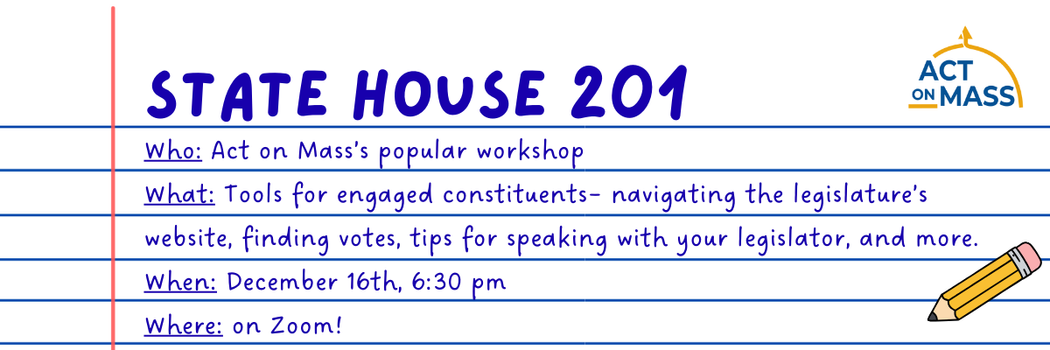
State House 201 returns! We'll be hosting our popular workshop on December 16th from 6:30 - 7:30 PM. This workshop will focus on the nuts and bolts of your interaction with the state house:
- How and where to find information about bills you care about on the website
- Where to find your member’s votes
- Identifying where your representative stands within the state house’s murky power dynamics
- Best practices for formulating communication with your legislator, including hard asks!
To boost your "citizen watchdog" skills, reserve your spot today!
Tell Your State Rep: Pass Strong Data Privacy Protection
From our friends at Progressive Mass: "Back in September, the Massachusetts Senate passed a robust data privacy bill that would prevent the purchase and sale of such sensitive data, along with other important measures to strengthen privacy rights. And last month, the House took the first step toward joining the Senate by voting a robust data privacy bill out of committee."
Fill out this form to send an email to your state rep asking them make our data protections a priority early next year!
TELL YOUR STATE REP: PASS DATA PROTECTIONS>>
---
That's the Scoop! Thanks for reading– have a lovely weekend.
In solidarity,
Scotia
Scotia Hille (she/her)
Executive Director, Act on Mass