I love when I get to start our Scoops with good news!
This week, Act on Mass and our allies dropped off 90,000 certified stipend reform ballot signatures at the Secretary of State’s office for the final round of verification. We are confident that this will allow us to cross the 74,574-signature threshold required to get the initiative on the ballot in 2026.
To every one of you who requested signature sheets, who badgered your friends and family to sign, who stood outside your grocery store or town meeting, who faced discomfort at interrupting people to inform them about legislator pay in the state house and why it matters for all of this: this victory is yours! Whether you got 3 signatures or 300, whether you took action yourself or simply passed on the word about our initiative: this huge result would not have been possible without you. Thank you for your support.
If Secretary Galvin’s office approves our question, the petition will move to the Legislature, where legislators get the chance to pass the measure themselves. Fun fact: I learned during our drop-off on Tuesday that the reams of signed petitions are physically moved to the State House during this period. Our petition was about 7 full-size boxes of paper– imagine that multiplied by 12 and you can understand a little better why legislative leaders find ballot questions annoying...
Oops, I'm engaging in a little foreshadowing. To the Scoop!
---
State House Scoop
Along with stipend reform, 11 other ballot question initiatives appear to have gathered enough signatures to advance to the next step. Check out WBUR for a rundown.
If all 12 questions advance, it would break Massachusetts’ record for the highest number of questions on a statewide ballot. The current record is 9, which happened in 1972, 1976 and 1994.
Although there are a number of petitions I am excited about (Public records law for the legislature! Rent control! Same-day voter registration! Incentivizing starter homes!), we should be clear about what this high number of ballot questions means: the public is being forced to do the legislature’s job for them.
On this subject, I’ll always think back to a conversation I had with one of my roommates before last year’s election. He worked long hours in a manual role and was not tuned in to the ins-and-outs of state politics. He expressed frustration about the increasing number of giant paragraphs on his ballot, covering niche policy areas like graduation requirements for MA’s 12th graders and “medical loss ratios” for dental insurance (??). He was happy to vote to support educators and workers, he said, but “isn’t this someone else’s job?”
In short: yes. There’s a reason that most modern republics adopt representative democracy rather than popular democracy. It takes time and effort to build policy expertise, debate proposals, and come to decisions democratically. If all of us had to clock in to Beacon Hill every week to weigh in on, uh, whether the Jurassic Armored Mud Ball should become the Official Sedimentary Structure of the Commonwealth of Massachusetts (and other pressing political issues), we wouldn’t have much else going on.
So, we use our tax dollars to pay 200 legislators and their 791 staff members year-round salaries to do the crucial work of making laws on our behalf. And, in Massachusetts, they routinely fail to even take votes on most legislation. Just pulling from news stories that came out this week**(!)**, here are a few things we are years behind on:
- Enacting common-sense fire safety reforms after deadly fires
- Loosening Puritan-era “blue laws” that ban alcohol sales on Thanksgiving and other holidays
- Requiring disclosure of previous flooding for home purchases – one of only 14 states in the country and one of only 3 coastal states that still do not
As an organizer and democracy defender, I will always be grateful for our right to direct democracy in Massachusetts, which allows the citizenry a direct say in the policies that impact our lives. However, when even a Beacon Hill insider like Secretary of State Bill Galvin (first elected in 1975!) resorts to a ballot question to force a vote on his policy, it’s clear that the problem starts at Beacon Hill.
The need to run a ballot campaign also drains resources from advocacy groups and redirects needed attention from legislative races. For example, unions can be powerful actors in state-level races, lending resources and manpower to challenger candidates. However, when years of inaction force them to dedicate all their time and resources to union-related ballot measures, less attention goes to candidate races – which is perhaps just how incumbents like it.
Endless ballot question are not the answer: we need a functional, effective, and responsive legislature. Consequential policy decisions should be made year-round. Instead of Googling “Chapter 62F pros cons” in line at the polling place next November, we should have all year to bug our state rep about it. Instead of spending hours canvassing for a common-sense policy change, we should be able to canvas for a candidate who says they’ll see it enacted and know that they can follow through.
For that, we need to take away leadership’s veto power over legislative progress. It’s why we’ve been calling the stipend reform question “the ballot question to end all ballot questions.” If we allowed ~196 legislators (and their staff!) to actually do the jobs they’ve been elected for, we’ll be looking at a much shorter ballot in 2028.
Legislative leaders want “transparency” from “groups”
Speaking of the ~4 people who control decision-making on Beacon Hill, they had their own reflections on the record-breaking number of ballot questions: “unease.”
Speaker Mariano expressed concern over “special interests groups” who “design questions that support their topics or their personal interests” and pay for signatures.
Said Senate President Spilka, “sometimes [ballot initiatives] are presented as grassroots, but when you look behind the curtain and see who is paying for the signatures, it is specific groups, and I think that that just needs to be more transparent.”
Friend, feel free to quote my response to that: HA!
The total amount of spending across all 5 ballot questions considered in 2024 was roughly $43.5 million. That includes signature gathering, advertisements, paid canvassers, and all other campaign expenses across the two-year ballot cycle. You could argue that the money would have been better spent on something else, but we can see which groups spent it and why. Conveniently, the exact language they supported or opposed ends up on everyone's ballot.
Meanwhile, in just 2024 alone, “specific groups” spent $104.1 million lobbying Beacon Hill. Lobbyists make salaries as high as $800,000 a year to stalk the hallways and backrooms of the state house with objectives that are often hard to pinpoint. Research suggests that high-power lobbying firms regularly succeed at blocking undesired legislation– even when they run against public opinion. Overall, it’s clear that moneyed interests prefer lobbying the legislature to the ballot to see their "personal interests" accomplished.
But good to know that Senate President Spilka prefers the “grassroots” to murky “groups” in influencing legislation. Maybe for her next move, she’ll stop using lobbyist donations to pay for her car rental?
Mariano confirms: state leaders govern like it’s 1994
Speaker Ron Mariano went on to complain specifically about the proposed rent control question. Despite the fact that MA voters consider “housing” to be the single biggest issue facing our state government, the legislature has shown reluctance to take significant policy action on high rental costs. Much like other issues we’ve discussed in this Scoop, this inaction forced housing groups to go to the ballot this year to overturn the state’s 1994 ban on rent control.
Mariano’s response to the proposed rent control question: “They had a statewide election on it… What has been the barrier for them finding out that people just don’t support it?” His spokesperson later confirmed that he was referencing the 1994 ballot question that banned rent control.
Here’s a secret: I (Scotia) was not alive in 1994! In the 31 years since, not only did I get born, learn to talk, and begin writing a weekly newsletter about Massachusetts’ broken state legislature, but our state’s population increased by more than 1,000,000 people. Meanwhile, the average cost of rent has more than tripled relative to inflation.
In 2025, we’re looking at a different world, a different electorate, and a public crying out for relief from an affordability crisis. Indeed, early polling suggests that 62% of Massachusetts voters would support a cap on rents.
Speaker Mariano is simply out of touch with the public. And so long as he and his corporate donors are allowed total control of the movement of legislation… we should be prepared to read some paragraphs on our ballots.
---
Support Act on Mass' end of year fundraiser!
Our incredible grassroots donors are what allows us to monitor the news from Beacon Hill around the clock, write our Saturday Scoop each week, and deliver it to your inbox free of charge. To keep this up next year, we need to raise $10,000 by the end of the year. If you've enjoyed reading the Scoop this year, please consider pitching in!
---
Syd's Sprinkles
Syd’s Sprinkles: Is Governor Healey Fighting For Our Climate Goals?
It would not be an overstatement to say that Massachusetts is a leader in climate and environmental efforts… or is it?
Throughout her gubernatorial career, our very own Governor Maura Healey has been especially contradictory in how she envisions Massachusetts' role in combating climate change and championing environmental projects.
In a recent (and ironic) instance of her contradictory rhetoric and actions, news of Governor Healey joining a coalition for fossil fuel usage broke around the same time as her environmental bond bill made it out of the Joint Committee on Environment and Nature in the state legislature [paywall].
Regardless of motivations and appearances, here’s the TLDR on what I’m talking about.
Governor Healey joined forces with 12 other Republican and Democratic governors to urge Congress to deregulate the energy industry in the United States, citing that “all forms of energy are equally beneficial; that excessive regulation is impeding needed energy infrastructure; that a lack of energy infrastructure is raising utility bills; and that winning the ‘AI race’ is in the public interest.”
You can read more about why these claims are misguided here, but the bottom line is that our governor is pushing for actions at the national level which would directly go against the issues she claims to advocate for at the state level.
How do we know this? It’s in her nearly $3 billion environmental bond bill.
Issues such as pollution, including addressing the serious health concerns of PFAS (a.k.a. “forever chemicals”) in our water supplies, and climate damage remediation has been championed by Healey through her bond bill. And while these are just some of the most immediate issues that arise from the proliferation of fossil fuel usage, climate events and change in general are aggravated by CO₂ emissions and other pollutants that come from fossil fuels.
It’s also important to note that Healey’s gubernatorial campaign platform had a large emphasis on a “rapid transition to clean energy,” through “swift, decisive, and comprehensive action.” So much so, that it earned the first spot in the list of priority issues on her campaign website.
More specifically, she championed preventing the production of gas pipelines in the state. And she did stop the production of two pipelines as Attorney General… but if you ask her about that nowadays she’ll most likely tell you that she “didn’t do that.”
While this is just one example of politicians playing semantics and contradicting themselves in their actions, it gets at the much bigger issue at play in our political climate here in Massachusetts.
And as much as we like to poke fun and call out some Massachusetts democrats as “Republicans in Democrats’ clothing,” some would say that this situation is most likely best described as our Governor looking out for her future political career interests while still attempting to appease constituents and climate advocates.
---
Worth reading: more stories from this week
Some other stories from this week relative to our state and our region:
- Coalition presses legislature for immigrant protections by Yawu Miller for Flipside News
- ‘Perfect storm of food insecurity’: State Anti-Hunger Task Force ramps up listening sessions by Joanna Malvas for Greenfield Recorder
- State’s plan for post-MCAS graduation requirements features both tests and projects by Katie Lannan for GBH
- State audit claims 2023 maternity unit closure in Leominster was preventable by Hallie Claflin for Commonwealth Beacon
---
Missed a Scoop or two? You can find a full archive of all past Saturday Scoops on our blog.
---
Take Action
State House 201
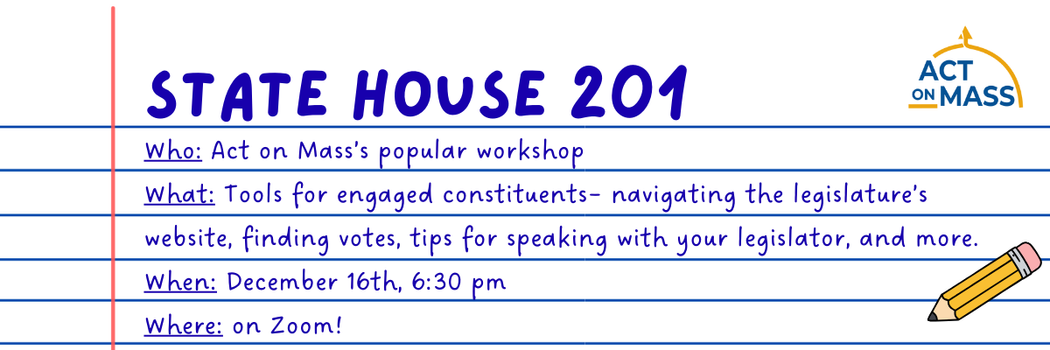
State House 201 returns! We'll be hosting our popular workshop on December 16th from 6:30 - 7:30 PM. This workshop will focus on the nuts and bolts of your interaction with the state house:
- How and where to find information about bills you care about on the website
- Where to find your member’s votes
- Identifying where your representative stands within the state house’s murky power dynamics
- Best practices for formulating communication with your legislator, including hard asks!
To boost your "citizen watchdog" skills, reserve your spot today!
Call to action: tell your senator to protect MA vaccination rates!

From allies with MFVA: "MA has the opportunity to become the next state to eliminate non-medical school vaccine exemptions by passing H.2554/S.1557."
"CA, CT, ME, and NY have all eliminated these exemptions in recent years and have seen subsequent improvements in their immunization rates against deadly diseases . As vaccine misinformation becomes more widespread - and is even disseminated by HHS on the federal level - it is more important than ever for Massachusetts to protect itself by eliminating this loophole in our vaccine requirements.
"H.2554 has been favorably advanced out of Public Health, but S.1557 is still awaiting review. Please email Massachusetts legislators through the Massachusetts Families for Vaccines websiteand call Public Health Senate Chair Senator Bill Driscoll at 617-722-1643 to ask the Joint Committee on Public Health to favorably advance S.1557. Save the date for MAFV's Day of Action at the State House on January 28, 2026!"
---
That's the Scoop! Thanks for reading– have a lovely weekend.
In solidarity,
Scotia
Scotia Hille (she/her)
Executive Director, Act on Mass