In case you missed our Tuesday email, I have an exciting update on last week’s Scoop: our mobilization worked!
On Monday, in response enormous to public pressure, leaders announced that the House would not move forward with Cusack’s “climate rollback bill” before the winter recess. Our state’s 2030 climate targets are safe– for now. If you seized the opportunity to contact your representative or tell friends about this shady legislation: thank you! This outcome was proof that our movement for transparency puts power back in the hands of citizens.
Having a watchdog team ready to respond around-the-clock is an important check on Beacon Hill’s shady practices. Act on Mass stays hard at work tracking news and legislation, coordinating with allies, drafting and distributing the Saturday Scoop every week, hosting informative workshops, tabling in cities and towns, etc. This year, we have managed to pull off all these activities with only one paid staff member, backed by wonderful volunteers and a supportive board. With your support, we can continue that momentum and build our capacity.
We’ve set a goal to raise $10,000 by the end of the year to make sure that we can keep up this important work. We are a small, scrappy organization: we can’t rely on big donors to keep us going. If you’ve benefited from our work this year, please consider pitching in to help us reach our goal. Thank you!
---
I've got two more exciting updates.
First of all: the campaign for stipend reform turned in at least 90,000 signatures to town and city clerks around the state, putting us on the track to clear the 74,574 signatures required. The events of the last week are only further proof that we need to free rank-and-file members from top-down control by leadership. Stay tuned for more updates as the campaign moves to the next phase!
Secondly, I am excited to introduce the Beacon Hill Compliance Tracker, designed by citizen developer Drew Bowler, in collaboration with Act on Mass and Progressive Mass. This tool responds to the legislature’s continued opacity and inconsistency with its own transparency rules.
Use this tool to track the extent to which your representative’s committees are following their own rules, and to find things like committee votes without having to navigate the legislature’s inscrutable website. You can also find out exciting and shocking statistics like– uh oh– the legislature has already broken its own rules on 40.5% of bills filed this year. I recommend taking some time to peruse.
And with that, to the Scoop!
---
State House Scoop
Legislature breaks for winter with little to show for their year
I hope you didn’t worry– I’d never let that reference to a “winter recess” slip by without some discussion.
The rumors are indeed true: lawmakers on Beacon Hill have concluded formal sessions for the year. Any legislative activity for the rest of the year will be in informal sessions, which tend to be poorly attended and are rarely used to pass significant legislation. Also: thanks to an earlier deadline, most committee work is expected to wrap up by the first week in December. This means that representatives may not return to Beacon Hill until next year.
Major takeaway: if you’ve ever considered running for state representative or senator (and you should!), make sure to factor in all that PTO!
In the year's last formal sessions this week, the only major legislation finalized was a $2.3 billion spending bill that closes the books on Fiscal Year 2025– which ended 4 months ago. Despite skyrocketing energy costs, we are heading into winter without affordability relief– or much else on the books.
As of Friday, 67 new laws had been finalized and sent to the governor this year. As far as we can tell, this was the lowest of any single year of legislative work in the last several decades. We followed up on some earlier analysis to check out what kind of laws made the cut this year.
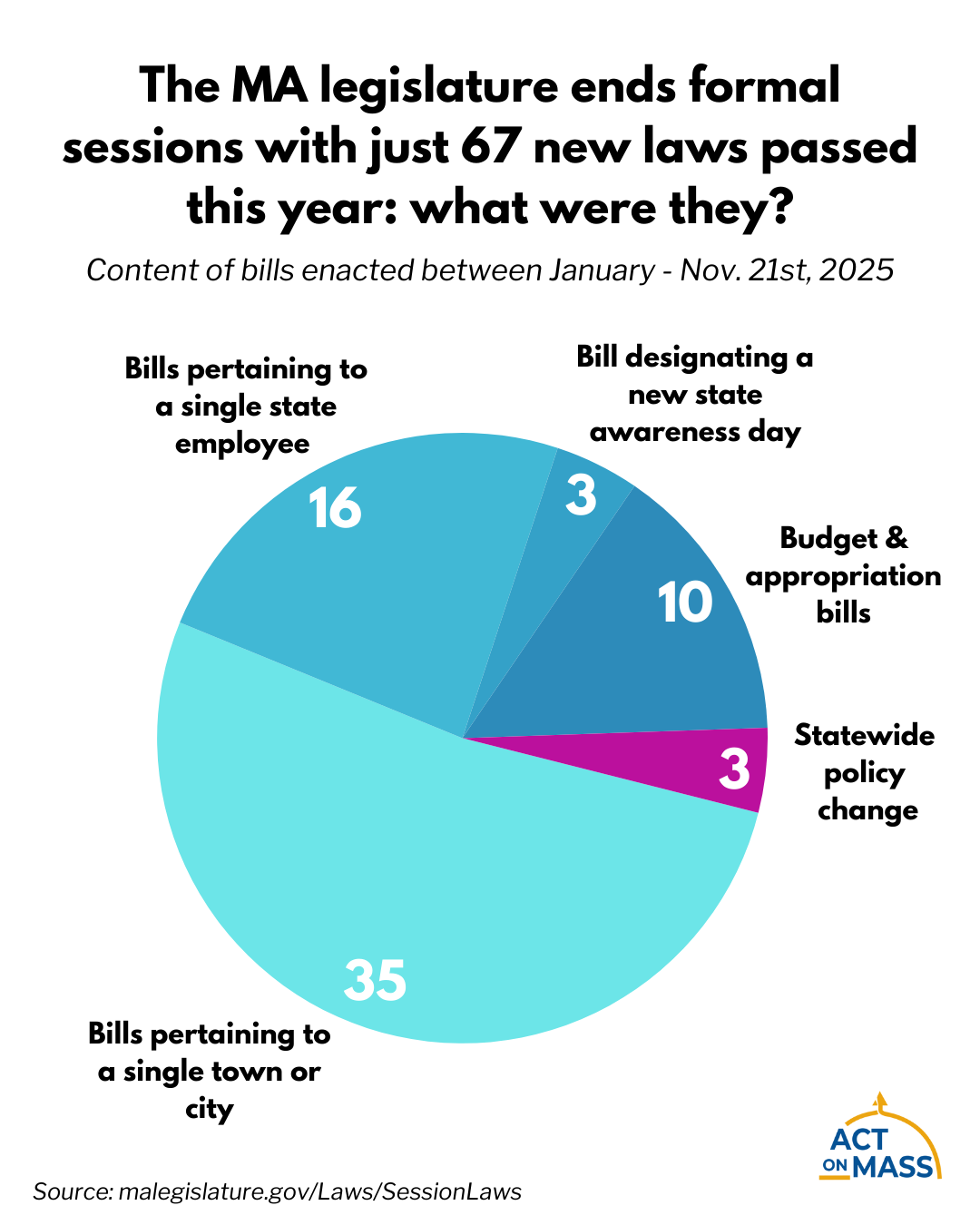
As you can see, our full-time state legislature has managed to finalize exactly as many new state awareness days in 11 months as new statewide laws. And that’s being generous– here are the three new statewide laws passed:
- A March 28th law to continue allowing cities and towns to allow remote access to public meetings, extending a COVID-era policy. This policy was set to expire on March 31st, so they had to pass this.
- A law moving the state primary date next year to two weeks earlier than the constitution requires, to September 1st, 2026, a date where many in the Boston area change address. In short, an incumbent protection measure.
- The updated SHIELD Law, shoring up protections for providers of transgender and reproductive care in Massachusetts.
Of these three, only the SHIELD Act really qualifies as a new statewide policy change being implemented to protect and benefit Bay Staters. We are glad they passed it! But in 11 months of full-time lawmaking, we should expect more. Make sure to check out Syd's Sprinkles for more on the impacts of inaction.
The legislature has passed a few other policy measures as policy riders on budget bills, including a ban on requiring tenants to pay broker fees that is projected to provide some relief on rental bills. However, even this was only finalized in August, after most new rentals were finalized for the year. For the most part, constituents will wait until next year or later to feel the impact of statewide policy changes.
Here’s the thing. Unlike many residents of Massachusetts, most of our legislators can count on the fact that they’ll have their job next year. In the last election, only 1 in 10 incumbents faced a primary challenge. We have the least competitive state elections in the country.
The lack of competitiveness directly impacts the health of our state democracy. It means that incumbents rarely have to defend their records to ensure reelection. It also means that representatives have little sense of urgency. If you know you’ll have your job in 2027, why rush to get things done in 2025?
So here’s my pitch: with just under a year until next year’s elections, start thinking about what names are going to be on your ballot next year. Even if you support your legislator and appreciate the work they do, it’s better for our democracy (and for their work output!) to have as many options as possible.
I’ve been taking inspiration recently from a group of women organizing in deep-red districts in North Carolina under the “Can’t Win Victory Fund.” They encourage candidates to intentionally run in elections they will lose in order to bring attention to progressive issues, boost voter turnout, and build long-term organizing capacity. At the top of their website, they call out North Carolina’s lack of competitive state elections as an inspiration for their push.
If they can take on incumbents in R+30 districts just to push for a better democratic process, surely we can challenge some entrenched Democratic incumbents in Massachusetts. Even if it's just because somebody should.
Have a friend or neighbor willing to spend a few weeks knocking doors next year? Thinking about it yourself? Start musing now. And send us an email about it. :)
---
Guest feature: Dan Zackin of 350 Mass
350 Mass Legislative Manager Dan Zackin writes about how the Senate Environmental Committee tried to quietly kill a popular bill
Last week Senate Environment Chair Rausch sent the Senate Make Polluters Pay/Climate Superfund Bill (S.588) to study– Beacon Hill code for killing the bill. This 48-hour vote via online form was started the night before advocates and legal experts were set to meet with committee staff to address outstanding questions. The Chair also launched this vote while the entire climate movement was laser focused on stopping the horrible House Climate Rollback Bill. While the final vote was incredibly close (2 in favor, 1 opposed, 2 reserve right), you would never know that from the records on the Legislature’s Website.
Chair Rausch and Senator Fernandes (S.588 cosponsor) voted to send the bill to study; Senator Rush voted to save the bill; and Senators Moore (S.588 cosponsor) and Tarr “reserved their right” or declined to take a position– did not vote for or against. Our campaign is grateful to Senator Rush for voting no, as well as Senators Moore and Tarr for reserving their right. Despite this, the Legislature’s website shows four members in favor and one reserved right on a bundle of eight bills including S.588. I visited committee members to confirm their votes, then the Chair’s staff, who told me they keep no record of votes.
I was sent on to the Senate Clerk who informed me that because bills are bundled into study orders, the “Committee Vote” section reflects legislators’ positions on the majority of bills. That means that the public can easily view committee votes in aggregate, but not on specific bills. Dissent on individual bills is only recorded in the obscure Senate Journal, which is not linked to the bill page. Not very transparent!
While an adverse (no) vote is recorded in the journal, reserving right is not. So for legislators who reserve their right on individual bill-study votes, we have to rely on their word alone. Anyone looking through these records could reasonably assume that the rest of the committee voted with the Chair.
The norm in Beacon Hill’s hierarchy is that members vote with their Chairs or face retribution. I’m grateful for legislators who abstained, but wonder if they know that their efforts are invisible in the record. Our recent transparency wins helped but our work is far from over. And while this disappointing decision decreases our chances of passing a climate superfund this session, we still have a shot. Our campaign is regrouping on December 2 to find the path around this new obstacle - join us!
Syd's Sprinkles
Syd’s Sprinkles: Legislative Inaction Impacts Bay State Children
One of the major responsibilities of government is to protect its constituents. This protection, among other and arguably lesser responsibilities, is why we citizens and residents legitimize the powers of the state.
Here in Massachusetts, where our representatives on Beacon Hill are becoming increasingly less active in their roles, our most vulnerable populations are continuously being put at risk when it comes to their rights and safety.
One of these most vulnerable groups is children. And while our Legislature has had ample opportunity to increase legal safety measures for kids, they have neglected to do so in key ways session after session.
Did you know that the age of consent in Massachusetts is 16 years old? This creates a “consent loophole” that makes it difficult to prosecute teachers and authority figures that establish relationships with children 16 and over. Massachusetts is one of only 11 states left that has no legal code preventing this kind of relationship. The state received national coverage in the New York Times this week for a devastating case tied to this legal loophole.
Despite being introduced in the Legislature each session since 2015, bills to close the “consent loophole” that puts students at risk of inappropriate sexual relationships have faced the same fate as many other no-brainer bills that have faced no opposition in the State House.
If all of our Legislators support this issue, why haven’t they addressed it when they’ve been given ample opportunity to do so?
According to New Bedford Senator Mark Montigny via the New Bedford Light, “there is still a tremendous amount of work that must be done to break through the inexcusable inertia on Beacon Hill.”
New Bedford Representative Mark Syliva also acknowledged the lack of transparency and action in the Legislature, telling the New Bedford Light that, “The fact that the revised bill was reported favorably out of Judiciary is significant considering how many issues die in any committee before they can see the same action.”
Without concrete legislative action, children in our communities will continue to be at risk of facing abuse at the hands of those meant to mentor them with no ways to adequately prevent and address it.
While Senator Joan Lovely has been filing bills to address the “consent loophole” since 2015, many believe that this session’s version has increased momentum given the bravery of victims who have spoken out about the abuse they had gone through [paywall].
You can – and should – read more about how these bills can protect children in the state here and reach out to your legislators to let them know that protecting children in Massachusetts is a priority of their constituents!
---
Worth reading: more stories from this week
Some other stories from this week relative to our state and our region:
- Act on Mass featured: High stakes, big money: What to know about the 2026 ballot question fights in Mass. by John Micek for MassLive
- Mass. party heads spar on ethics of public tips to ICE by Adam Reilly for GBH
- Taiwanese government paid thousands for New England lawmakers to visit by Chris van Buskirk for WBUR
- A sitdown with Mass. Senate president: Spilka wants to ‘be bold’ on housing by Katie Lannan for GBH News
---
Missed a Scoop or two? You can find a full archive of all past Saturday Scoops on our blog.
---
Take Action
Call to action: tell your senator to protect MA vaccination rates!

From allies with MFVA: "MA has the opportunity to become the next state to eliminate non-medical school vaccine exemptions by passing H.2554/S.1557."
"CA, CT, ME, and NY have all eliminated these exemptions in recent years and have seen subsequent improvements in their immunization rates against deadly diseases . As vaccine misinformation becomes more widespread - and is even disseminated by HHS on the federal level - it is more important than ever for Massachusetts to protect itself by eliminating this loophole in our vaccine requirements.
"H.2554 has been favorably advanced out of Public Health, but S.1557 is still awaiting review. Please email Massachusetts legislators through the Massachusetts Families for Vaccines websiteand call Public Health Senate Chair Senator Bill Driscoll at 617-722-1643 to ask the Joint Committee on Public Health to favorably advance S.1557. Save the date for MAFV's Day of Action at the State House on January 28, 2026!"
Support Act on Mass' end of year fundraiser!
Help us keep our mission alive, including sending this weekly newsletter, by helping us reach our goal of raising $10,000 by the end of the year! Thank you.
---
That's all for today. Thanks to Dan for sharing his organization's experience with convoluted Beacon Hill process. And thanks to all those that have supported Act on Mass over the years! No Scoop next week, but expect to hear from us in December. Happy holidays.
In solidarity,
Scotia
Scotia Hille (she/her)
Executive Director, Act on Mass